Discuss Through WhatsApp
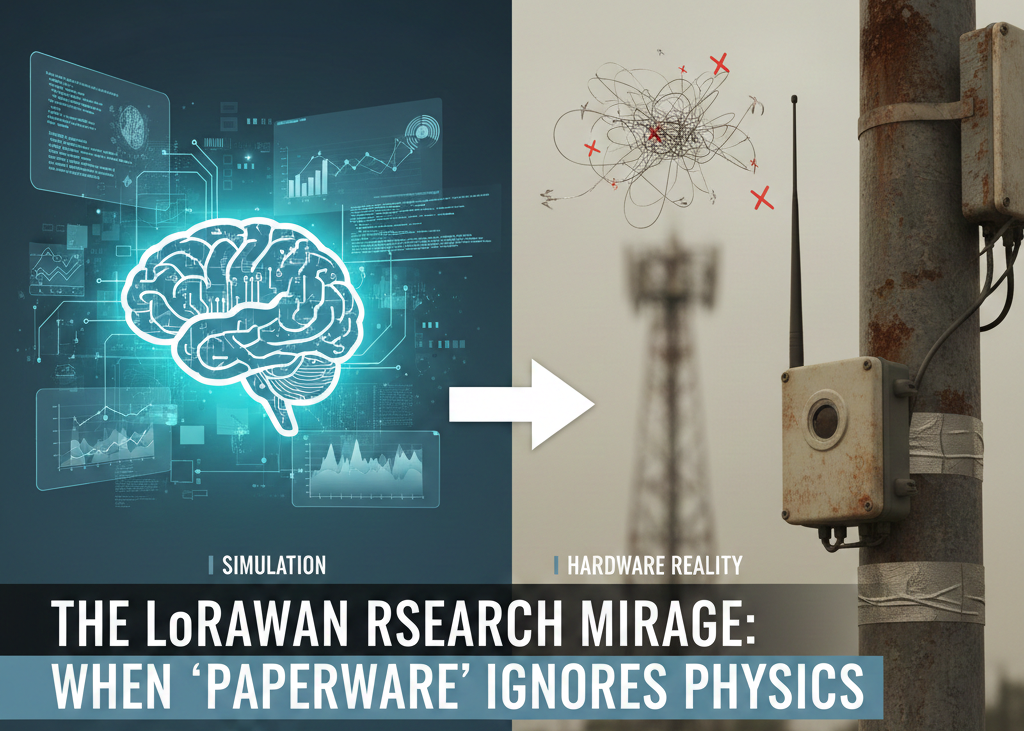 In the world of Internet of Things (IoT) research, there is a growing divide between the mathematical elegance of published journals and the gritty, physics-constrained reality of hardware. LoRaWAN, designed as a low-power, long-range, low-data-rate protocol, has become the favorite playground for scholars.
However, a troubling trend has emerged: researchers are increasingly treating LoRaWAN like a high-speed cellular network. They are proposing “intelligent,” mobile, high-bandwidth models that—while looking great in a simulation—would fail the moment they touched a real-world gateway.
Here is an exposé on the “Research Ignorance” currently plagueing LoRaWAN scholarship, and why “Paperware” models are setting the industry up for failure.
1. The Mobility Myth: LoRaWAN is Not 5G
A common theme in recent papers involves “High-Speed Mobile LoRaWAN” for vehicular tracking or real-time drone telemetry. These papers often propose complex handover mechanisms and high-frequency updates.
The Reality Check:
LoRaWAN uses an unslotted ALOHA access method. It doesn’t “hand over” a connection from one tower to another; it simply broadcasts into the void, hoping a Gateway (GW) hears it.
- The Collision Problem: When you increase the frequency of messages (high-rate data) in a mobile environment, the probability of “collisions”—where two packets overlap and destroy each other—increases exponentially.
- The “Deaf” Gateway: To maintain high-rate data, nodes often require Acknowledgments (ACKs). But LoRaWAN gateways are half-duplex. While a gateway is sending an ACK to one “intelligent” mobile node, it is stone-deaf to the emergency signals of thousands of other devices.
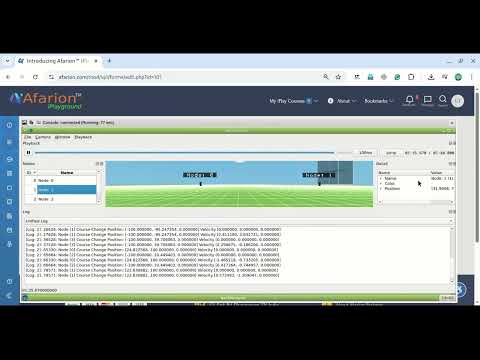
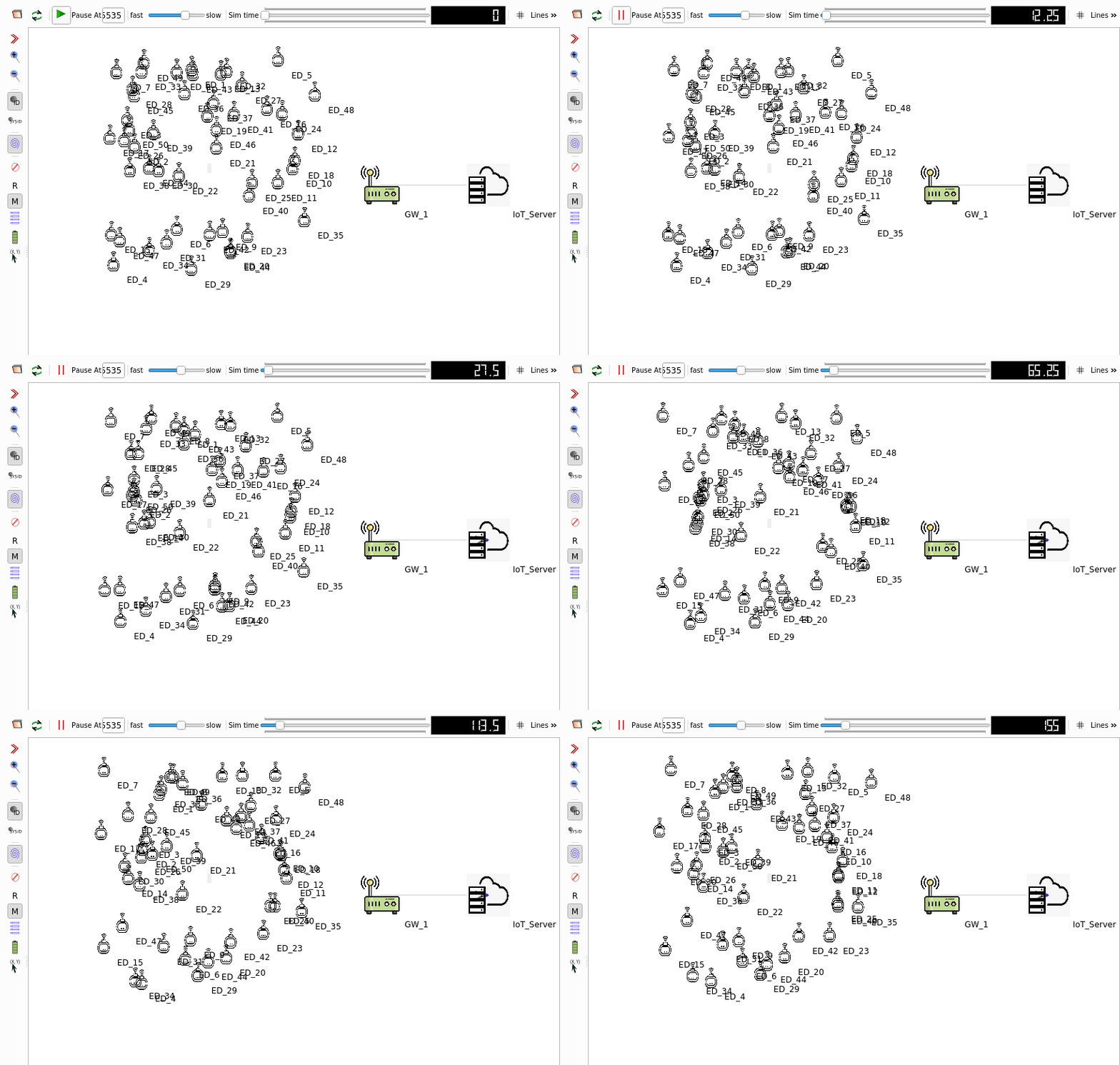
In the following output, the movement of nodes is only presented to visualize a mobile LoRaWAN network scenario. But a practical LoRaWAN only give meaningful performance at very, very low mobility.
2. The ADR Trap: ML Cannot Fix Physics
The most popular “academic” trend is applying Machine Learning (RL, CNNs, or Swarm Intelligence) to Adaptive Data Rate (ADR). Scholars assume the Network Server (NS) can “learn” the perfect Spreading Factor (SF) in real-time for a moving node.
The Conflict:
- The 20-Packet Rule: Standard ADR requires a history of roughly 20 packets to calculate a stable link margin.
- The Convergence Crisis: If a node is moving, the RF environment changes every second. By the time an ML algorithm “converges” on the optimal parameters for Position A, the node has already moved to Position B behind a concrete wall.
- The Result: The “optimized” node is constantly using the wrong SF, leading to massive packet loss and wasted battery.
3. The “GPS-is-Free” Fallacy
Many researchers assume that a LoRaWAN End Device (ED) can simply “know” its location via GPS and share it with the Gateway to help the Network Server optimize the path.
The Reality Check:
- Power Hunger: A GPS/GNSS fix can pull 30mA to 50mA for several seconds. In contrast, a LoRa transmission is a quick pulse. Adding GPS to a LoRaWAN node destroys the “10-year battery life” promise.
- Payload Bloat: LoRaWAN payloads are tiny (often limited to 51 bytes at higher SFs). Sending 12 bytes of GPS coordinates in every packet consumes nearly 25% of your bandwidth just to say where the sensor is, rather than what it’s sensing.
Comparing Intent vs. Reality
To understand why these research papers are often “Paperware,” we have to look at the mismatch between academic ambition and the LoRaWAN standard.
4. The Duty Cycle: The Law Researchers Forget
In the unlicensed bands (868 MHz / 915 MHz), the law is king. Most regions enforce a 1% Duty Cycle.
The Math of Failure:
If a “high-rate” researcher sends a packet that takes 500ms to transmit (common at SF12), that device is legally required to remain silent for the next 49.5 seconds. You cannot “optimize” or “AI-manage” your way out of a legal requirement. Papers that simulate 100 packets per minute are not describing LoRaWAN; they are describing an illegal radio jammer.
5. The Energy Efficiency Paradox
Researchers often claim they are using LoRa for bulk data because it is “low power.” This is a fundamental misunderstanding.
Fact: LoRa is efficient for sending a few bytes. If you try to send 1MB of data over LoRa, the radio must stay in “Transmit Mode” for so long that it actually consumes more energy than a high-speed 4G/5G burst.
6. The AI Code Generation Trap: “Working” vs. “Legal”
With the rise of Large Language Models (LLMs), many researchers and developers are now using AI to generate their LoRaWAN firmware. You can ask an AI to “write a LoRaWAN Class A uplink script that sends data every 10 seconds,” and it will provide perfectly functional C++ or Python code. It will compile, it will run, and your gateway will receive the packets.
But just because the code works doesn’t mean it’s legal.
The Logic vs. The Law
AI models are trained on logic, not on the shifting sands of regional RF legislation.
- The “Interval” Ignorance: If an AI generates a loop that sends data every 10 seconds at Spreading Factor 12 (SF12), it is creating a device that violates the 1% Duty Cycle law in Europe within minutes. A single SF12 packet can have a Time-on-Air (ToA) of nearly 1 second. To stay legal, that device must remain silent for 99 seconds—yet the AI-generated code will happily try to transmit again 89 seconds too early.
- The Regional Blind Spot: AI often defaults to “generic” settings. A script written for the US (where Dwell Time of 400ms is the limit) will fail certification in Europe (where Duty Cycle is the limit).
- The “no_free_ch” Reality: High-quality radio stacks (like the Semtech LoRaMAC-node) have built-in safeguards that will return a no_free_ch (No Free Channel) error if you try to send too soon. However, many “simple” code snippets generated by AI or found in GitHub repos bypass these official stacks to “keep it simple,” effectively turning your research node into a rogue jammer.
Why “Working Code” is Often Illegal: A Deep Dive
When we talk about software, “working” usually means the output matches the input. In the world of Licensed and Unlicensed Spectrum, “working” is secondary to “compliance.” Here is why AI and “Paperware” researchers often miss the mark:
i. Lack of “Regulatory Awareness” in Code
Most LoRaWAN libraries (like MCCI LMIC or LoRaWAN-node) are complex because they have to manage Regional Parameters. This includes frequency hopping, RX window timing, and duty cycle tracking.
- Researcher Shortcut: To save time, researchers often write “Raw LoRa” code instead of a full “LoRaWAN Stack.”
- The Danger: Raw LoRa code doesn’t track how long the radio has been active. It treats the airwaves like an infinite resource. If your AI-generated code doesn’t explicitly implement a Duty Cycle Aggregator, you are breaking the law the moment you hit “Upload.”
ii. The Capture Effect and Fairness
Regulations exist to ensure “Spectrum Fairness.” If your “working” code sends bulk data, you aren’t just succeeding; you are actively “blinding” every other sensor in a 5km radius.
- Because LoRa uses Coded Orthogonal Signals, a node sending a “bulk” file at a high power level will trigger the Capture Effect, where the gateway locks onto its signal and ignores dozens of smaller, legally-compliant packets from water meters or smoke detectors.
iii. Certification is Not a Logic Check
A device that “works” in a lab will fail CE (Europe), FCC (USA), or IC (Canada) certification if its firmware allows it to exceed airtime limits. Many scholars publish papers based on performance metrics (throughput, latency) achieved by “tuning” the code to ignore these limits.
The Peer-Review Red Flag: If a paper claims a LoRaWAN throughput of more than a few kilobits per second over a sustained period, they haven’t found a “new optimization”—they’ve simply written code that would be seized by the FCC in the real world.
Conclusion: We Need “Hardware-in-the-Loop”
The academic community is currently building a library of “solutions” for problems that don’t exist, using constraints that aren’t real.
Until research scholars move away from idealized NS-3 or MATLAB simulations and start testing with actual SX1302 silicon in a real urban environment, the gap between “Published Science” and “Working Technology” will continue to grow. We don’t need more ML-optimized ADR for high-speed trains; we need reliable, simple protocols for the billions of stationary sensors that LoRaWAN was actually built for.
Stop trusting “paperware” models and ideas. Discover why high-rate, mobile LoRaWAN research often ignores the physics of ADR and duty cycles, leading to models that fail in reality
 Take Me to Afarion ns-3 iPlayground