Discuss Through WhatsApp
The following article explores the evolving communication landscape of ns-3. It highlights the delicate balance between high-speed developer collaboration and the need to preserve public knowledge for both researchers and AI tools, while maintaining the absolute integrity of the core source code.
Human Logic vs. AI Artifacts: The future impact of ns-3’s Closed Zulip Chat
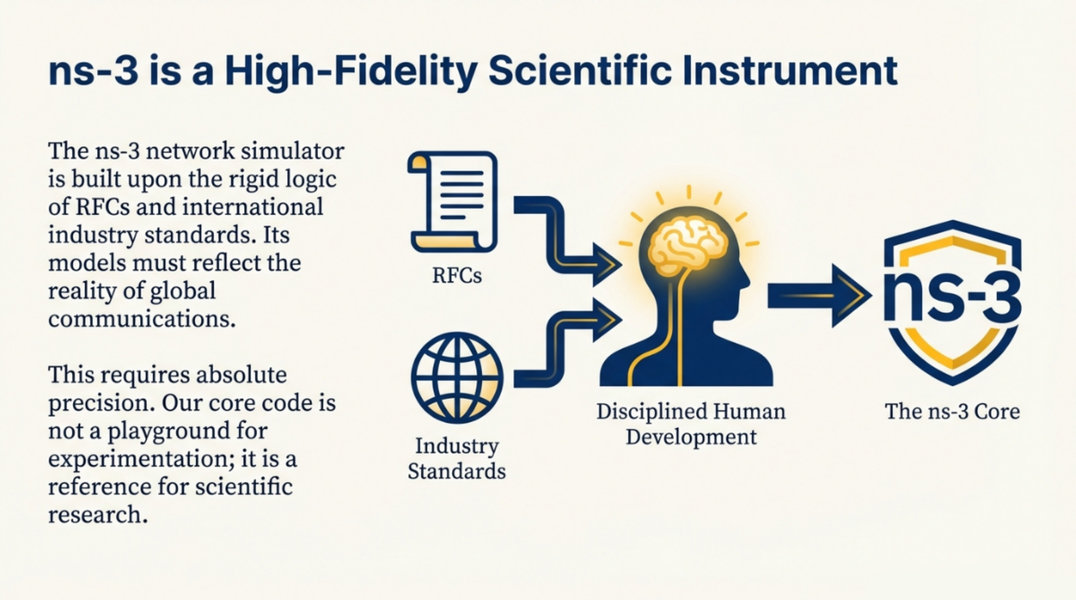
The ns-3 network simulator is not just a software project; it is a high-fidelity scientific instrument. Because its models must reflect the reality of global communications, the simulator is built upon the rigid logic of RFCs and international industry standards. As the community’s communication methods evolve—utilizing Zulip as a real-time chat room alongside traditional platforms like Google Groups, Wikis, and GitLab—we must address how this shift impacts the project and the role of Artificial Intelligence (AI).
1. Protecting the Core: Why AI Should not “Build” ns-3
Before examining how knowledge is shared, we must establish a fundamental guardrail: AI is not the architect of ns-3.
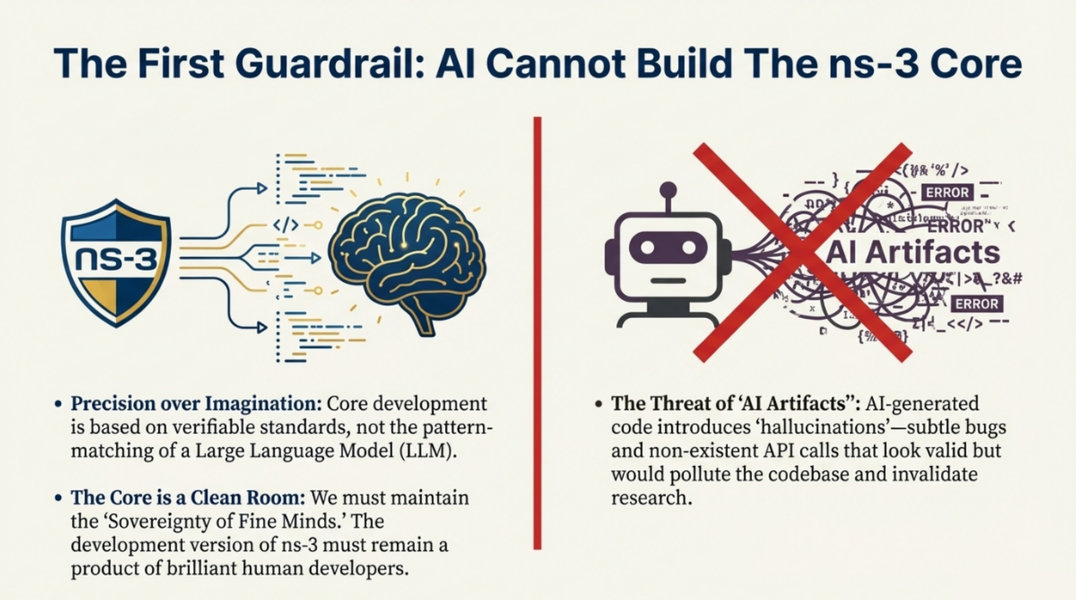
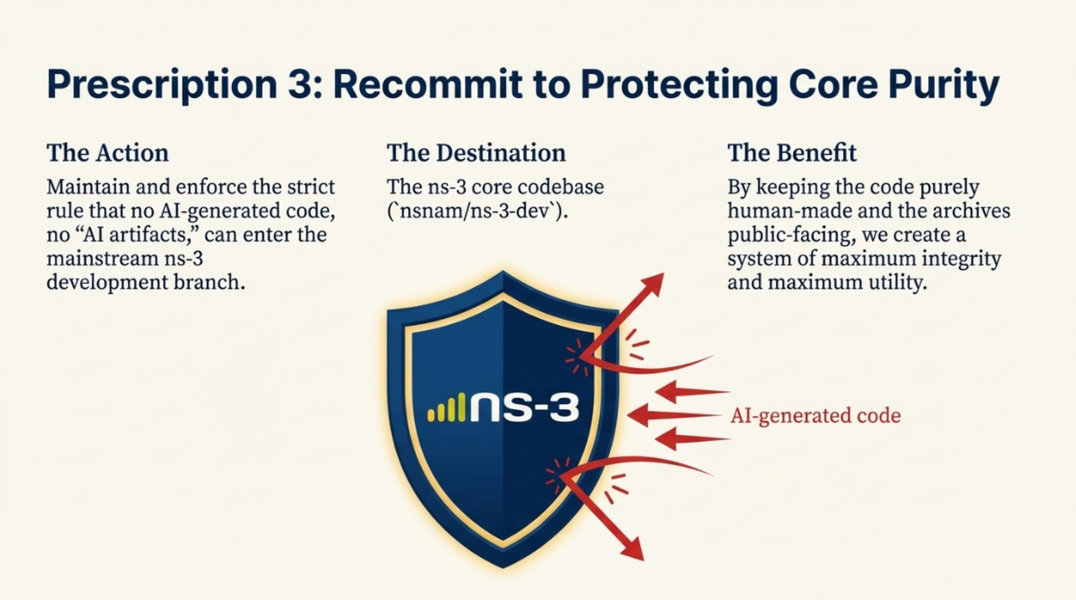
We are not talking about allowing AI to modify the mainstream ns-3 development code. ns-3 is a complex software that evolves through a progressive, human-led process.
- Precision over Imagination: Core development is based on industry standards, not the “imagination” or pattern-matching of an LLM.
- Avoiding Pollution: AI-generated code often contains “hallucinations”—segments that look like valid C++ but contain non-existent API calls or logic flaws. These “AI artifacts” would pollute the mainstream code, introducing subtle bugs that could invalidate years of scientific research.
- The Sovereignty of Fine Minds: The development version of ns-3 must remain a product of the fine minds and disciplined imagination of brilliant human developers. The core must stay a “clean room,” free from AI-generated errors.
2. The Power of “Ignorant” Questions
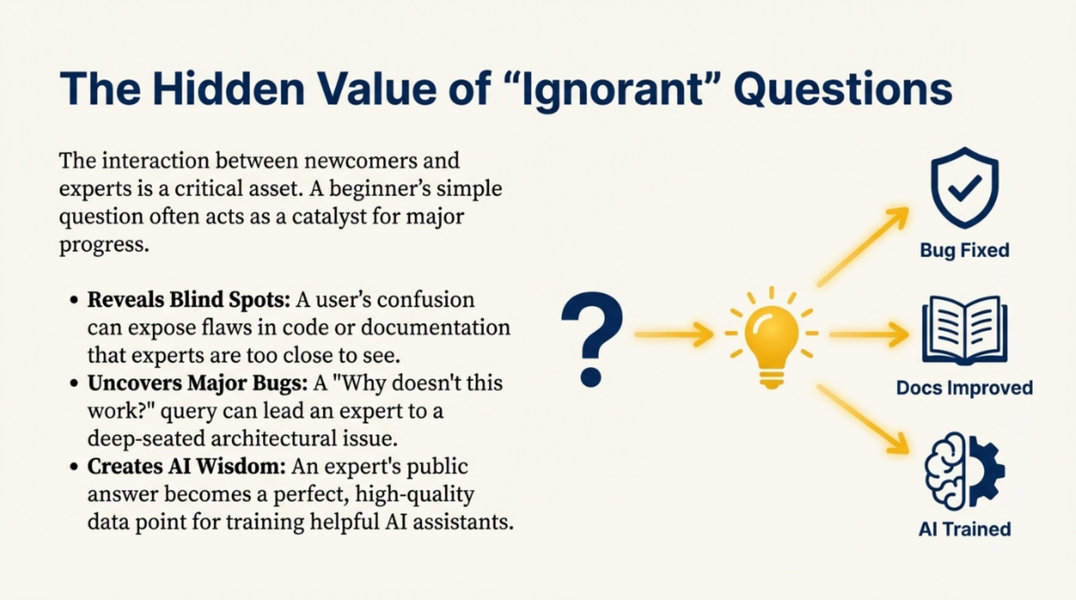
One of the most vital parts of the ns-3 ecosystem is the interaction between amateur users and expert developers. Whether on the Google Group or in the Zulip chat room, the questions asked by beginners are often more important than they seem.
Even an “ignorant” or simple question from a newcomer can act as a catalyst for major progress. When an expert takes the time to answer a basic query, several things happen:
- Identifying Hidden Flaws: A beginner’s confusion often reveals a “blind spot” in the code or documentation that the experts, who are too close to the project, might have missed.
- Solving Major Issues: Sometimes, a simple “Why does this not work?” leads an expert to discover a deep-seated architectural bug or a bottleneck in the current development version.
- Fueling AI Wisdom: When an expert provides a detailed, correct answer to a simple question, they are creating a high-quality “data point.” If this interaction is public, AI bots learn the correct human logic, making them much more helpful to the next thousand users who encounter that same problem.
3. The Fragmented Knowledge Map
If AI is excluded from building the core, its primary role is assisting users with their own simulation scripts. However, to be a good assistant, the AI needs to “read” the latest expert-verified information. Currently, that information is spread across several layers:
- The Public Blueprint (GitLab & Wiki): The official history of changes is found at nsnam/ns-3-dev. By tracing Merge Requests and Commits, one can see exactly why a human expert made a change. Furthermore, GSoC project discussions and progress may be found in public Wiki pages, GitHub, or other dedicated public pages.
- The Documentation Layer: Sites like cttc-lena.gitlab.io provide the “rules” for specific modules like 5G-LENA. These are easily indexed by search bots and AI.
- The Zulip Chat Room: This is where the real-time, “serious” developer talk may sometimes happen. While final results are documented elsewhere, the preliminary and early-stage discussions may take place here. These informal brainstorms could contain the “why” behind the code—context that often never makes it into a formal commit message.
4. The Lessons of the “Olden Days” (ns-2)
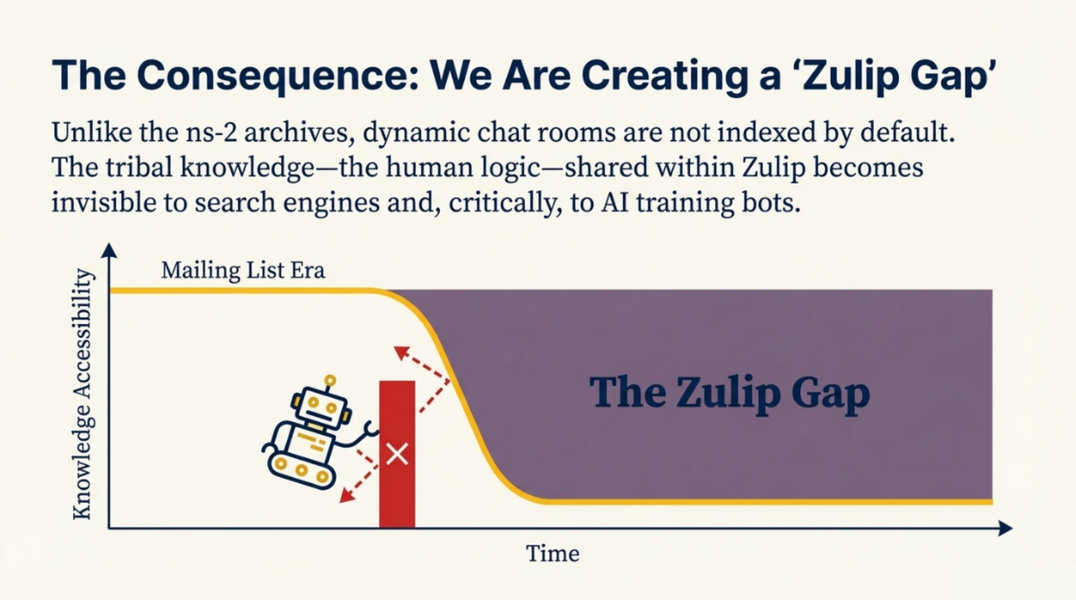
The shift toward using a chat room for early-stage development talk risks creating a “Knowledge Silo.” In the era of ns-2, the community relied on mailing lists that were aggressively mirrored.

- Public Mirrors: Services like ISI.edu and The Mail Archive turned every technical email into a searchable HTML page.
- AI Training: Because that data was so public and redundant, modern AI models “learned” ns-2 deeply.
- The Zulip Gap: Unlike those old archives, a chat room is a dynamic environment. If early-stage discussions or expert answers to amateur users stay trapped in a chat room, they become invisible to search engines. Over time, AI tools will lose touch with the “human logic” of ns-3, causing them to give outdated advice even as the simulator moves forward.
5. Why ns-3 Forum and Chat Discussion Should be Kept Open to Public?
Recent research and web traffic data confirm that popular public forums are seeing a marked decline as users migrate toward private, instantaneous AI interactions.
i. The Statistical Decline: “The Stack Overflow Effect”
The most visible evidence of this shift comes from major developer hubs. Since the launch of ChatGPT, traffic to public Q&A sites has plummeted.1
- Traffic Drop: According to data from SimilarWeb, Stack Overflow saw a traffic decrease of roughly 14% to 20% year-over-year following the surge in LLM popularity.
- The “Zero-Click” Search: A 2024 study by Gartner predicted that search engine volume for traditional websites will drop by 25% by 2026 as users transition to AI chatbots for direct answers.2
- ns-3 Impact: Smaller, niche communities like the ns-3-users Google Group are experiencing a “quieting.” While experts still post, the high-volume “beginner-to-intermediate” questions that once drove engagement are now being directed to AI, reducing the group’s overall activity and visibility.
ii. The Feedback Loop: Why Forums are “Losing Their Glory”
The decline of these forums creates a negative feedback loop that harms the ecosystem in several ways:
a. The Loss of “Expert-Verified” Archives
In the past, a question on a public forum was answered by a human expert. That answer became a permanent, verified public record that others could find via Google. AI, by contrast, provides a private, ephemeral answer. If the AI is wrong (hallucinates), only that one user is misled. If an expert is wrong on a forum, the community corrects them publicly.
b. Reduced Motivation for Mentors
Experts and maintainers often contribute to forums because they enjoy the visibility and the feeling of helping a “living” community. As forums become ghost towns, the social incentive for experts to participate vanishes.
c The “Stale Data” Problem
As users stop posting new questions and solutions on public forums, the internet “dries up” for future AI training.
- LLMs are parasites of public data: They need the constant flow of forum discussions to learn about the latest ns-3 releases (e.g., updates in ns-3.43).
- The Paradox: By using AI instead of forums, users are inadvertently ensuring that the next generation of AI will be less knowledgeable because there will be no new public forum data to train on.
iii. The “Invisibilizing” of Nuance
Recent research into developer behavior suggests that while AI is faster, it lacks the “accidental learning” that forums provide.
- The Peripheral Learning Gap: On a Google Group or Zulip chat, a user might go looking for one answer but stumble upon an expert’s discussion regarding a major architectural flaw or a new RFC standard.
- Tunnel Vision: AI provides a direct path to a specific solution, which is efficient but prevents the user from seeing the “bigger picture” of the simulator’s development.
iv. The Specific Risk to ns-3
For a complex, scientifically-grounded tool like ns-3, the “Glory” of the forum was the rigorous debate.
- Standards vs. Hacks: A forum expert will tell you, “Your code works, but it violates the 3GPP standard.” * AI Artifacts: An AI will often give you a “hack” that compiles but produces scientifically invalid results.
As the ns-3-users group and Zulip chats see fewer public interactions, the “Gold Standard” of peer-reviewed informal advice is replaced by the “Pattern Matching” of an AI that doesn’t actually understand physics or networking protocols.
5. A Call to Action: Reviving the Archive Spirit
To ensure ns-3 remains the world’s leading network simulator, the community should ensure its “Chat Room”(or at least, the open topic Zulip chats) doesn’t become a “Bunker.”
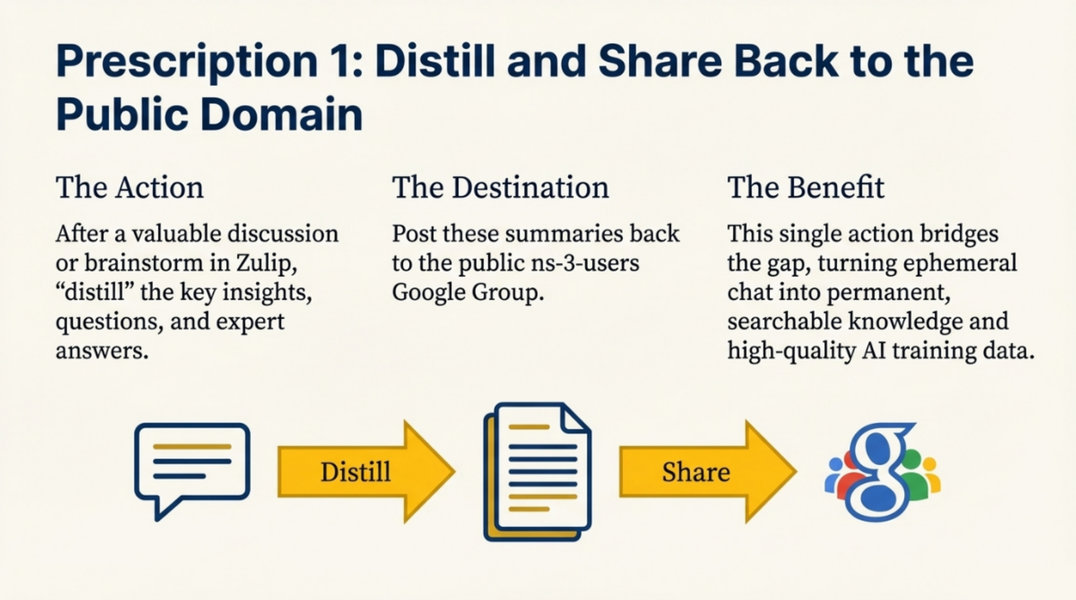
- Bridging the Gap: Developers and students should be encouraged to “distill” their best Zulip brainstorms and expert answers and post them back to the ns-3-users Google Group.
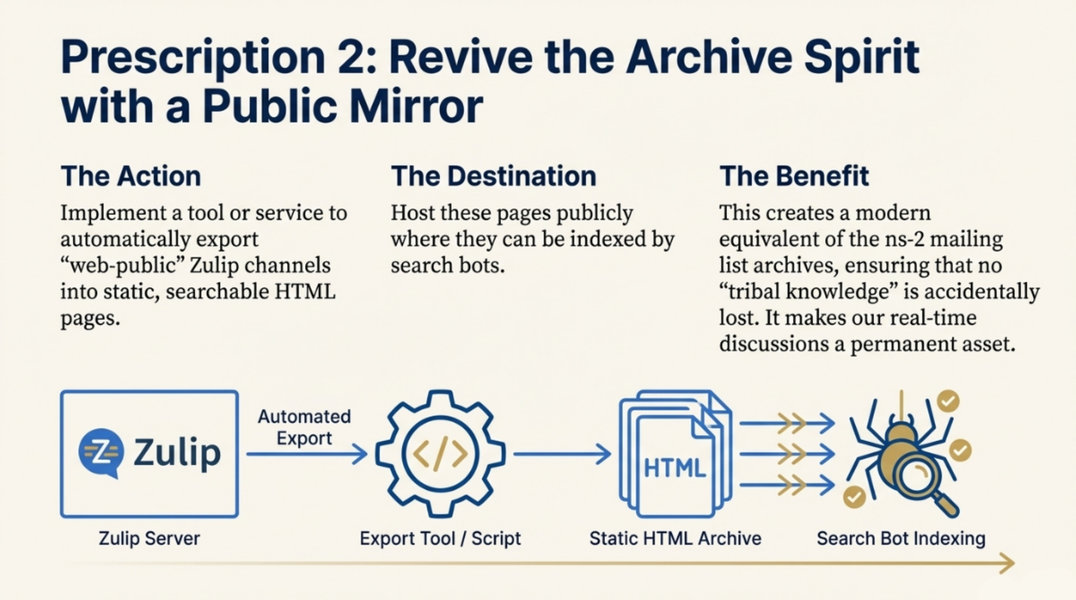
- Public Backups: The community could use tools to turn open topic Zulip channels into static HTML pages. This allows search bots to index the “tribal knowledge” that would otherwise be lost.
- Protecting Purity: We must maintain the strict rule that no AI artifacts enter the mainstream code. By keeping the code human-made and the archives public-facing, we get the best of both worlds: a simulator of the highest scientific integrity and an AI ecosystem that is actually helpful to the users.
6. Conclusion: Can ns-3 forums and Chats Survive?
The “Glory” of public forums is tied to their role as a Community Memory. To survive, forums like ns-3-users must evolve. We may see a shift where forums are no longer for “first-line” questions (which AI handles) but are reserved for high-level technical debates, GSoC project deep-dives, and “Knowledge Bridges” that humans intentionally build to keep the community visible.
The parallel use of ns-3-users Google Group, GitLab, Wikis, and the Zulip chat room is highly efficient for the developers building ns-3. However, we must ensure that the “human logic” discussed in early-stage open topic Zulip chats and expert answers to beginners is eventually mirrored to the public domain. This prevents future “digital dark age or ns-3″(for AI) and ensures that while humans continue to build the fine ns-3 core logics, AI can still effectively help the users.
 Take Me to Afarion ns-3 iPlayground