Discuss Through WhatsApp
Why Is It Difficult to Understand 1G, 2G, 3G, 4G, 5G, and the Future 6G
Networks?
How Did They Evolve Historically, What Changed Technologically, and How Can
They Be Simulated in ns-3?
1. Why Do 1G–6G Cellular Networks Cause So Much Conceptual Confusion?
The confusion mainly arises because three distinct domains are often mixed
together:
- Radio signal theory (waves, modulation, spectrum)
- Network engineering (packets, protocols, routing)
- Simulation abstraction (models, not physical reality)
Cellular generations are defined mostly by radio access and core-network architecture, whereas ns-3 operates at the packet and protocol level. Once this separation is understood, the apparent complexity becomes manageable.
2. What Does the Term “Generation (G)” Actually Represent?
A new “G” does not simply mean higher data rates. It marks a fundamental architectural shift in one or more of the following:
| Dimension | What changes across generations? |
| Multiple access | FDMA → TDMA → CDMA → OFDMA |
| Switching | Circuit → Packet → Service-based |
| Core network | PSTN → EPC → SBA |
| Target users | Humans → Machines → Everything |
| Latency philosophy | Best-effort → Guaranteed |
| Simulation complexity | Low → Extremely high |
Thus, each generation reflects a new network philosophy, not just faster
radios.
3. What Was 1G and Why Can’t It Be Simulated in ns-3?
📜 Historical perspective
1G systems (1980s) such as AMPS and NMT were designed purely for analog voice communication.
📡 Technological characteristics
- Analog FM
- FDMA
- Circuit-switched
- No data, no encryption
🧪 Simulation perspective
ns-3 cannot simulate 1G, because:
- It is analog and continuous
- No packet-based communication exists
- No protocol stack is present
👉 1G belongs to communication theory, not network simulation.
4. How Did 2G Improve Upon 1G, and Why Is It Still Hard to Simulate?
📜 Historical perspective
2G (1990s) introduced digital cellular communication, with GSM becoming dominant worldwide.
📡 Technological characteristics
| Aspect | 2G |
| Modulation | GMSK |
| Access | TDMA + FDMA |
| Core | Circuit-switched |
| Data | SMS, low-rate data |
Enhancements:
- GPRS (2.5G): packet data
- EDGE (2.75G): higher throughput
🧪 Simulation perspective
ns-3 does not implement GSM PHY/MAC.
Researchers usually model:
- Traffic flows
- Delays and losses
- Abstract access links
👉 2G is conceptually modeled, not realistically simulated.
5. What Did 3G Change, and Why Is Its Simulation Rare in ns-3?
📜 Historical perspective
3G (UMTS/WCDMA) enabled mobile internet access for the first time.
📡 Technological characteristics
| Aspect | 3G |
| Access | CDMA |
| Modulation | QPSK |
| Switching | Circuit + Packet |
| Core | Transitional |
Key idea:
All users transmit simultaneously, separated by spreading codes.
🧪 Simulation perspective
- CDMA requires chip-level signal modeling
- ns-3 avoids waveform simulation
👉 Full 3G simulation is rare; it is often approximated or skipped.
6. Why Is 4G (LTE) the Turning Point for ns-3 Simulation?
📜 Historical perspective
4G LTE (2010 onward) made the internet truly mobile.
📡 Technological breakthroughs
| Layer | LTE Innovation |
| Access | OFDMA / SC-FDMA |
| Core | All-IP EPC |
| Latency | ~10 ms |
| Services | Video, VoIP, cloud apps |
Key abstraction:
Time–frequency resource blocks dynamically allocated by schedulers.
🧪 Simulation perspective
✅ Full LTE support exists in ns-3
Simulated components include:
- Abstract PHY (SINR-based)
- MAC schedulers
- RLC / PDCP
- EPC core network
- Mobility and handover
- QoS and energy models
👉 This is why LTE is the baseline cellular model in ns-3 research.
7. What Makes 5G Different from 4G, and How Well Can ns-3 Model It?
📜 Historical perspective
5G targets humans and machines, not just smartphones.
📡 Technological advancements
| Feature | 5G |
| Spectrum | Sub-6 GHz, mmWave |
| Latency | <1 ms |
| Core | Service-Based Architecture |
| New ideas | Slicing, virtualization |
Three use cases:
- eMBB
- URLLC
- mMTC
🧪 Simulation perspective
⚠️ Partial support in ns-3
- 5G NR module (LTE-like abstraction)
- mmWave module (beamforming, blockage)
Researchers can study:
- Latency
- Scheduling
- Mobility and handover
- Directional communication
8. What Is 6G Expected to Be, and Can It Be Simulated Today?
📜 Vision and motivation
6G aims to integrate communication, sensing, intelligence, and space
networks.
📡 Expected technological directions
| Area | 6G Vision |
| Spectrum | Sub-THz / THz |
| Control | AI-native |
| Architecture | Cell-less |
| Integration | Satellite + UAV + terrestrial |
| New paradigm | Communication + sensing |
🧪 Simulation perspective
❌ No standardized 6G modules exist.
However, ns-3 can still be used to:
- Prototype architectural ideas
- Implement AI-driven schedulers
- Study non-terrestrial and deep-space links
- Analyze energy and scalability
👉 6G simulation today is custom, exploratory research, not standards-based.
9. What Exactly Does ns-3 Simulate—and What Does It Ignore?
What ns-3 simulates well
- Packet flow
- Delay, throughput, loss
- Scheduling and queuing
- Mobility
- Energy consumption
What ns-3 does not simulate
- I/Q samples
- Waveforms
- Antenna radiation
- Hardware impairments
👉 ns-3 is a network-level simulator, not a signal-level one.
10. How Do Cellular Generations Map to ns-3 Support?
| Generation | ns-3 Capability |
| 1G | ❌ |
| 2G | ❌ (abstract only) |
| 3G | ❌ (approximate) |
| 4G LTE | ✅ Full |
| 5G NR | ⚠️ Partial |
| 6G | 🔬 Conceptual / Custom |
11. What Is the Simplest Mental Model to Remember All Generations?
1G–3G → How do we make voice mobile?
4G → How do we make the Internet
mobile?
5G → How do we guarantee performance?
6G → How do we make
networks intelligent?
12. What Is the Key Takeaway for Teaching and Research?
- Do not present generations as speed upgrades
- Emphasize architectural shifts
- Use LTE as the anchor model in ns-3
- Extend toward 5G and future 6G concepts
- Always explain simulation abstraction limits
This approach removes confusion and builds correct intuition for students and
researchers.
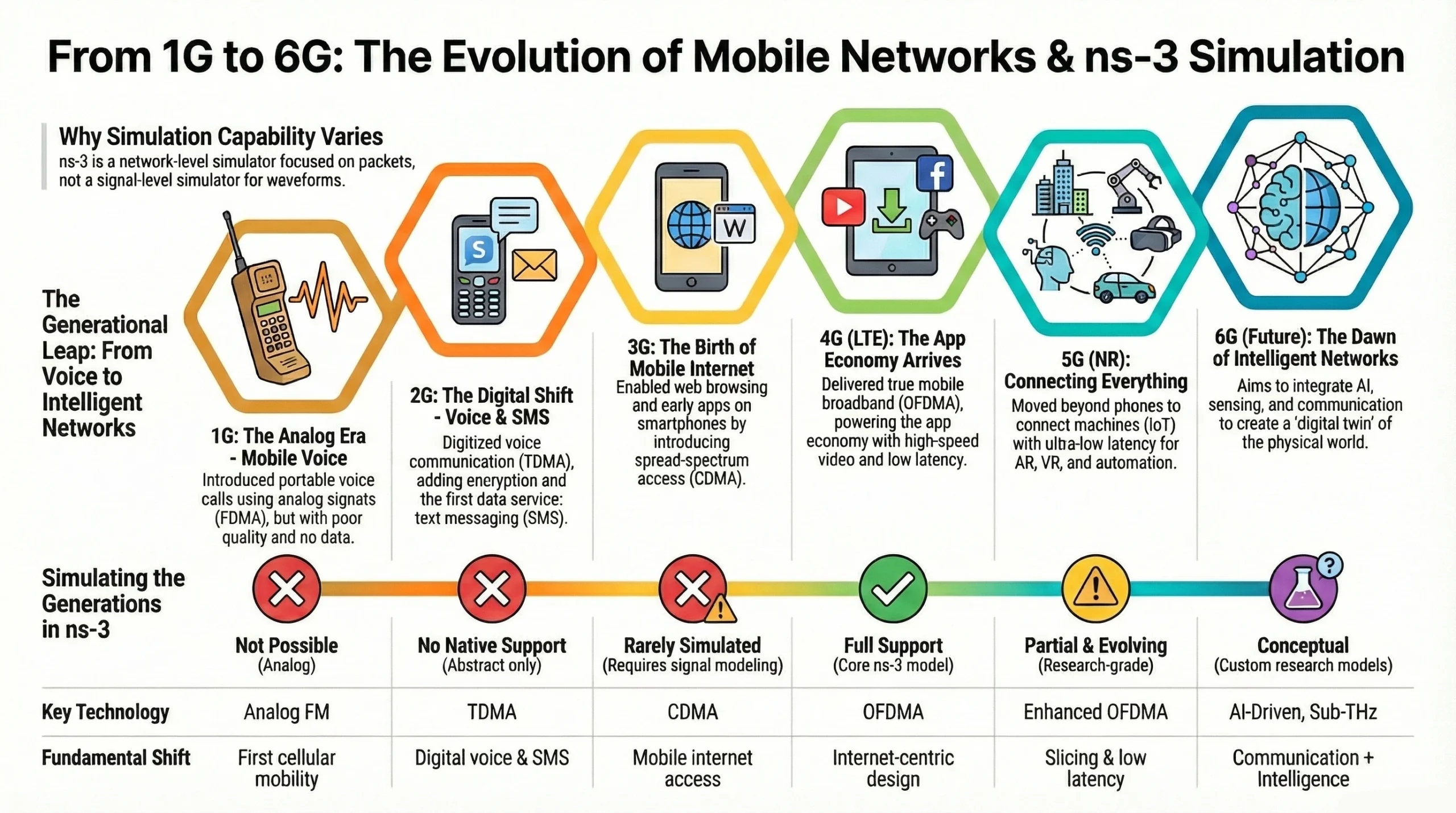
Comparison Chart: 1G → 6G and ns-3 Simulation Perspective
| Generation | Era | Primary Goal | Radio Access & Modulation | Core Network | Key Services | Fundamental Shift | ns-3 Simulation Support |
| 1G | 1980s | Mobile voice | FDMA, Analog FM | Circuit-switched (PSTN) | Voice only | First cellular mobility | ❌ Not possible (analog, no packets) |
| 2G | 1990s | Digital voice & SMS | TDMA + FDMA, GMSK | Circuit-switched | Voice, SMS | Digital cellular communication | ❌ No native support (abstract only) |
| 2.5G / 2.75G | Late 1990s | Basic data | TDMA, GMSK / 8-PSK | Circuit + Packet | SMS, email, WAP | Packet data introduced | ❌ Abstract modeling only |
| 3G | 2000s | Mobile internet | CDMA, QPSK | Hybrid (CS + PS) | Web, multimedia | Spread-spectrum access | ❌ Rarely simulated (too PHY-heavy) |
| 4G (LTE) | 2010s | Mobile broadband | OFDMA / SC-FDMA, QAM | All-IP (EPC) | Video, VoIP, apps | Internet-centric design | ✅ Full support (core ns-3 cellular model) |
| 5G (NR) | 2020s | Performance guarantees | Enhanced OFDMA, mmWave | Service-based core | eMBB, URLLC, mMTC | Slicing, low latency | ⚠️ Partial & evolving |
| 6G (Future) | 2030+ | Intelligent connectivity | Sub-THz / THz, AI-driven | AI-native, cell-less | XR, sensing, space-net | Communication + intelligence | 🔬 Conceptual / custom research |
Quick Interpretation Guide
| Question | Answer |
| Are generations just about speed? | ❌ No — they reflect architectural revolutions |
| Why is LTE dominant in ns-3 research? | It balances realism and abstraction |
| Why can’t ns-3 simulate 1G–3G well? | They require waveform-level PHY modeling |
| Is 5G fully standardized in ns-3? | Not yet — still research-grade |
| Can 6G be simulated today? | Conceptually, using custom models |
One-Line Memory Hook
1G–3G: Making voice mobile
4G: Making the Internet mobile
5G: Making
performance predictable
6G: Making networks intelligent
 Take Me to Afarion ns-3 iPlayground