Discuss Through WhatsApp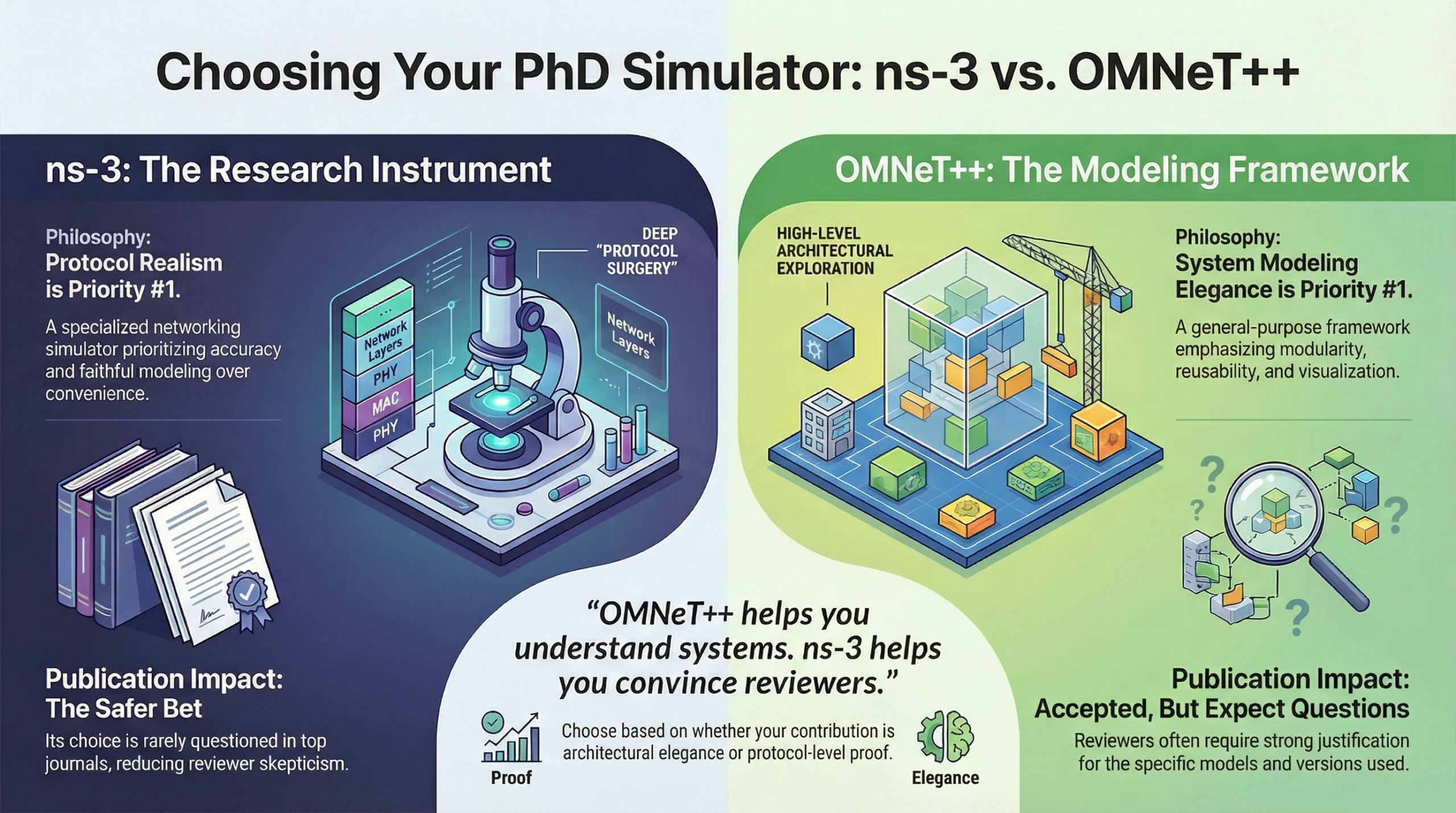
This article provides a Ph.D.–centric comparison of ns-3 and OMNeT++, written from the actual expectations of a CSE/ECE doctoral scholar (problem depth, publishability, model credibility, extensibility, and long-term research value), rather than from a beginner or industry-demo perspective. I’ll be explicit and opinionated where it matters.
1. What a Ph.D. Scholar Actually Expects from a Simulator
A doctoral researcher typically expects:
-
Scientific credibility (reviewers trust results)
-
Ability to modify protocol internals
-
Faithful modeling of PHY/MAC/network layers
-
Reproducibility and transparency
-
Long-term extensibility (3–5 years of research)
-
Acceptance in top journals/conferences
-
Low “simulation bias” accusations
Keep these in mind while reading the comparison.
2. Philosophical Difference (Very Important)
ns-3 Philosophy
“Simulation as a research instrument”
-
Focused only on networking
-
Prioritizes accuracy over convenience
-
Minimal abstraction at protocol boundaries
-
Designed for protocol and system-level research
OMNeT++ Philosophy
“Simulation as a modeling and visualization framework”
-
General-purpose discrete event simulator
-
Networking is one application domain
-
Emphasizes modularity, reusability, and visualization
-
Ideal for system behavior exploration
📌 Implication for Ph.D. work
-
ns-3 → protocol realism
-
OMNeT++ → system modeling elegance
3. Module Availability — How It Really Matters in Ph.D. Work
ns-3
-
Modules are:
-
Few but deep
-
Mostly first-party
-
Maintained with strict review
-
-
Examples:
-
LTE, 5G NR (3GPP-aligned)
-
Wi-Fi (802.11a/b/g/n/ac/ax)
-
TCP variants (BBR, Cubic, etc.)
-
Energy, spectrum, propagation models
-
-
Modules are often used directly in published papers
➡️ Less variety, more depth
OMNeT++
-
Massive ecosystem via:
-
INET
-
Veins
-
Castalia
-
MiXiM
-
-
Many modules are:
-
Developed by individual research groups
-
Frozen after a project
-
Uneven in documentation and correctness
-
➡️ More variety, uneven depth
📌 Ph.D. Reality
Reviewers will ask:
“Is this model validated? Who maintains it?”
This question is easier to answer with ns-3.
4. Quality of Models (This Is Where Ph.D. Work Is Won or Lost)
ns-3 — Model Quality
-
Strong emphasis on:
-
Mathematical correctness
-
Layer interactions
-
Packet-level realism
-
-
Supports:
-
PCAP tracing
-
Real TCP/IP stacks (DCE)
-
-
Reviewers perceive ns-3 as:
“Closer to real networks”
OMNeT++ — Model Quality
-
Excellent for:
-
High-level abstractions
-
Behavioral modeling
-
Architectural experimentation
-
-
However:
-
Some PHY/MAC models are simplified
-
Timing and queueing assumptions vary across frameworks
-
📌 Key Ph.D. Insight
-
If your contribution is algorithmic/architectural, OMNeT++ is fine
-
If your contribution is protocol/PHY/MAC, ns-3 is safer
5. Code-Level Freedom (Critical for Doctoral Research)
ns-3
-
You can:
-
Modify TCP congestion window logic
-
Change MAC backoff equations
-
Rewrite PHY error models
-
-
Encourages deep code engagement
-
Your thesis can legitimately say:
“We modified the internal behavior of protocol X”
OMNeT++
-
Often encourages:
-
Plugging modules together
-
Parameter tuning
-
-
Deep modification across layers is harder and messier
📌 For a Ph.D.
Hands-on protocol surgery → ns-3 wins
6. Publication & Reviewer Perception (Unspoken Truth)
ns-3
-
Very common in:
-
IEEE TWC
-
IEEE TCOM
-
IEEE JSAC
-
IEEE IoT Journal
-
-
Rarely questioned why ns-3 was chosen
OMNeT++
-
Accepted, but often questioned:
-
“Which framework?”
-
“Which version?”
-
“Is this model validated?”
-
📌 Reality Check
Using ns-3 removes one entire line of reviewer attack.
7. Learning Curve vs Research Payoff
|
Aspect |
ns-3 |
OMNeT++ |
|
Initial learning |
Hard |
Moderate |
|
Time to first result |
Slower |
Faster |
|
Depth of contribution |
Very high |
Moderate–high |
|
Long-term payoff |
Excellent |
Good |
📌 Ph.D. Rule:
If it feels hard initially, it’s probably research-grade.
8. Visualization & Debugging (Not as Important as You Think)
OMNeT++
-
Excellent GUI
-
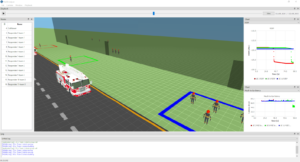
Live packet animations
-
Great for teaching and demos
ns-3
-
Minimal visualization
-
Relies on logs, traces, plots
📌 Ph.D. Perspective
-
Your thesis examiner cares about:
-
Graphs
-
Equations
-
Validation
Not animated packets.
-
9. Thesis Longevity (3–5 Year Horizon)
ns-3
-
Stable APIs
-
Backward compatibility mindset
-
Easier to extend year after year
OMNeT++
-
Framework updates may break older models
-
Dependency chains can grow complex
📌 Long Ph.D. projects favor ns-3
10. IEEE Journals ↔ Simulator Preference
(ns-3 vs OMNeT++ from a Reviewer’s Lens)
This section presents a practical, Ph.D.-oriented mapping of major IEEE journals and their simulator preference, based on reviewer expectations, historical usage patterns, and what typically gets questioned during peer review in CSE/ECE networking research.
This is written the way senior Ph.D. scholars and supervisors actually think, not as a marketing material.
Tier-1 Core Networking Journals
IEEE Transactions on Wireless Communications (TWC)
Preferred: ✅ ns-3
Accepted: ⚠️ OMNeT++ (with strong justification)
Why ns-3?
- Tight PHY–MAC interaction
- Wireless realism (propagation, spectrum, interference)
- Many accepted papers explicitly cite ns-3
Reviewer mindset:
“Did they use a realistic wireless stack?”
📌 Recommendation: ns-3 is the safe default
IEEE Transactions on Communications (TCOM)
Preferred: ✅ ns-3
Also acceptable: MATLAB + ns-3 hybrid
Focus:
- Protocol behavior
- End-to-end performance
- Transport & MAC layer effects
📌 OMNeT++ may trigger:
“Which PHY/MAC assumptions were used?”
IEEE Journal on Selected Areas in Communications (JSAC)
Preferred: ✅ ns-3
Occasionally: Analytical + ns-3 validation
Why?
- JSAC reviewers expect deep realism
- Often cross-check simulation against theory
📌 OMNeT++ is acceptable only if abstraction level is clearly justified.
Wireless, IoT & Emerging Networks
IEEE Internet of Things Journal (IoT-J)
Preferred: ✅ ns-3
Accepted: OMNeT++ (Castalia / INET)
Typical topics:
- LoRaWAN
- NB-IoT
- Energy models
- MAC scheduling
📌 If PHY accuracy or energy modeling is central → ns-3 is safer
IEEE Transactions on Vehicular Technology (TVT)
Preferred: 🔄 Both
- ns-3 → protocol & wireless stack
- OMNeT++ (Veins) → vehicular mobility + traffic
📌 Strong OMNeT++ acceptance only when Veins/SUMO integration is used properly.
IEEE Wireless Communications Letters (WCL)
Preferred: ✅ ns-3
Also common: MATLAB simulations
Reason:
- Short papers
- Results-focused
- ns-3 adds credibility quickly
Systems, Architecture & Cross-Layer Research
IEEE Systems Journal
Preferred: 🔄 OMNeT++
Accepted: ns-3
Why OMNeT++ works well:
- Modular architecture
- System-level abstraction
- Visualization-supported explanations
📌 ns-3 fine if networking dominates the system.
IEEE Access
Preferred: 🔄 Both
- ns-3 → protocol-heavy work
- OMNeT++ → architecture/system models
📌 Reviewers are flexible but expect clarity.
Security, Edge & Cloud Networking
IEEE Transactions on Network and Service Management (TNSM)
Preferred: 🔄 Both
- OMNeT++ for management frameworks
- ns-3 for network performance impact
IEEE Transactions on Dependable and Secure Computing (TDSC)
Preferred: 🔄 Both
- ns-3 if attack impacts protocol behavior
- OMNeT++ if system-level security logic dominates
Aerospace, Space & Specialized Domains (ECE-heavy)
IEEE Transactions on Aerospace and Electronic Systems
Preferred: ✅ ns-3
Why?
- PHY realism
- Propagation modeling
- Time-delay modeling
📌 OMNeT++ rarely seen unless abstracted system models are used.
IEEE Sensors Journal
Preferred: 🔄 Both
- OMNeT++ (Castalia) → WSN logic
- ns-3 → realistic wireless evaluation
Summary Table (Quick Decision Guide)
| IEEE Journal | Preferred Simulator |
| IEEE TWC | ns-3 |
| IEEE TCOM | ns-3 |
| IEEE JSAC | ns-3 |
| IEEE IoT Journal | ns-3 |
| IEEE TVT | ns-3 / OMNeT++ |
| IEEE WCL | ns-3 |
| IEEE Systems Journal | OMNeT++ |
| IEEE TNSM | Both |
| IEEE TDSC | Both |
| IEEE Sensors Journal | Both |
| IEEE Access | Both |
Supervisor-Level Advice (Very Important)
If your paper might be rejected, let it be for the idea — not the simulator.
Using ns-3:
- Reduces reviewer skepticism
- Requires less simulator justification
- Is safer for first Ph.D. publications
Using OMNeT++:
- Powerful if your contribution is architectural
- Requires stronger explanation of model assumptions
11. Final Verdict (Clear & Honest)
✅ Choose ns-3 if:
-
You are a CSE/ECE Ph.D. scholar
-
Your work involves:
-
Protocol design
-
Wireless systems
-
PHY/MAC/network interaction
-
Realistic performance evaluation
-
-
You aim for top-tier IEEE journals
👉 ns-3 is the safer, more credible, and more defensible choice
✅ Choose OMNeT++ if:
-
Your work is:
-
System-level
-
Cross-domain (networks + mobility + behavior)
-
Architecture or algorithm exploration
-
-
Visualization and rapid prototyping matter
👉 OMNeT++ excels in modeling elegance, not protocol realism
One-Line Ph.D. Advice (Very Important)
OMNeT++ helps you understand systems.
ns-3 helps you convince reviewers.
 Take Me to Afarion ns-3 iPlayground