Discuss Through WhatsApp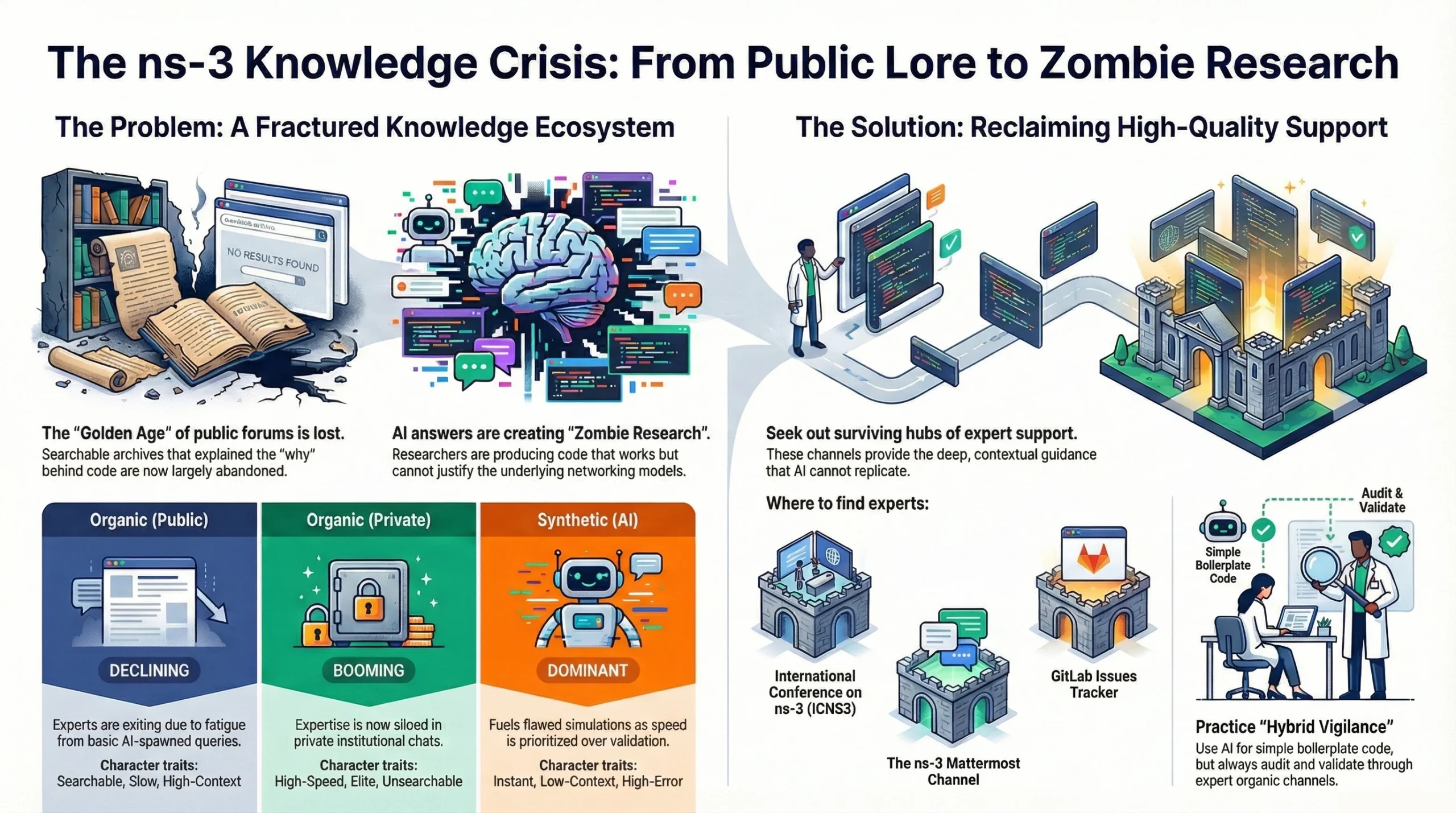
For years, ns-3 has been the gold standard for network simulators. It is a complex, high-fidelity tool used by researchers to simulate everything from 5G towers to satellite constellations. But today, veteran researchers are worried. They are witnessing a “quiet tragedy”: the slow death of the community-driven support systems that once turned students into experts.
As we move away from public forums and toward AI-powered answers and private chats, we aren’t just changing how we get help—we are losing the deep “lore” and architectural wisdom required to do real science.
1. The Google Groups Era: A Library That Never Slept
In the “Golden Age” of ns-3, most help happened on the ns-3-users Google Group. This wasn’t just a place to fix bugs; it was a living library.
When a student asked about a bug in an LTE simulation in 2012, they didn’t just get a line of code. They got a response from a lead maintainer who explained the “why”. They would explain how the C++ code mapped to specific 3GPP standards and why certain trade-offs were made.
- The Strength of Permanence: Because these conversations were public and searchable, a solution written ten years ago could still educate a researcher today.
- The Loss of Context: Today, these archives are gathering dust. When a researcher asks an AI for help with a WifiHelper, the AI might provide code that runs, but it won’t explain the physics behind it. It won’t tell you if your error model contradicts the real-world behavior of radio waves.
2. The Rise of “Zombie Research”
The old forums acted as a form of informal apprenticeship. If a junior researcher posted a model that used impossible physics—like a car “teleporting” across a map—a senior developer would step in. They would explain why a Gauss-Markov model is better for randomness than a simple ConstantVelocity model.
The AI Shortcut
LLMs (Large Language Models) provide instant gratification. They fix the syntax errors so the code compiles, but they don’t challenge the user’s logic. This leads to what experts call “Zombie Research”:
- Papers are published with perfect-looking code.
- The authors cannot explain their model choices.
- Results show “impossible” things, like zero-latency networks, because the AI patched the surface without fixing the underlying science.
3. The Fragmentation of Support
Support for ns-3 has split into three main “silos.” Each has a different impact on the quality of research:
| Support Type | How it Works | The Result |
| Public Organic | Forums and Mailing Lists | Declining. Experts are tired of answering basic AI-generated questions and are leaving. |
| Private Organic | Private Slack or Discord groups | Booming. But this knowledge is “hidden” behind walls and isn’t searchable by the public. |
| Synthetic (AI) | ChatGPT, Claude, etc. | Dominant. It’s fast but often wrong about complex networking details. |
This table shows a scary trend: real expertise is becoming “private,” while the “public” space is being filled with shallow AI advice.
4. Why This Matters: The Threat to Standards
Networking research isn’t just about making code run; it’s about following Standards (like those from IEEE or the IETF). In the past, “forum elders” would jump on a thread and say, “Your idea for a new protocol is cool, but it violates the 802.11ax hardware limits.”
AI doesn’t know these limits. It might suggest a protocol that works in a simulation but could never be built into a real-world Wi-Fi chip. This creates “Paperware”—research that looks great on a PDF but is useless to the telecommunications industry.
5. Where the “Old Spirit” Still Lives
If you want to be a serious researcher, you have to look beyond the AI chat box. The organic spirit of ns-3 survives in a few key places:
- ICNS3 (International Conference on ns-3): This is the best place for face-to-face mentoring. It’s where the “badges of reproducibility” are earned.
- Mattermost & Zulip: These are the modern “headquarters” for ns-3. Zulip, in particular, acts as a bridge. It offers real-time chat but keeps things organized so that experts can still mentor newcomers.
- GitLab Issue Tracker: This is where the real work happens. Every discussion is tied directly to the source code.
6. How to Reclaim the High Ground
We don’t have to stop using AI, but we must use it wisely. Here is the path forward for the modern ns-3 researcher:
- Use AI for “Boilerplate”: Let AI help you write simple C++ loops or basic setup code.
- Audit with Human Logic: Never trust an AI’s choice of a propagation loss model or a handover algorithm without checking the official ns-3 documentation.
- Contribute Back: When you solve a problem and want to share it with others, post it on the ns-3 users group or GitLab or Zulip channels.
The future of 6G, autonomous vehicles, and global connectivity depends on simulations that are real, not just simulations that run. We must choose the hard path of understanding over the easy path of “LLM-Ware.”
 Take Me to Afarion ns-3 iPlayground