Discuss Through WhatsApp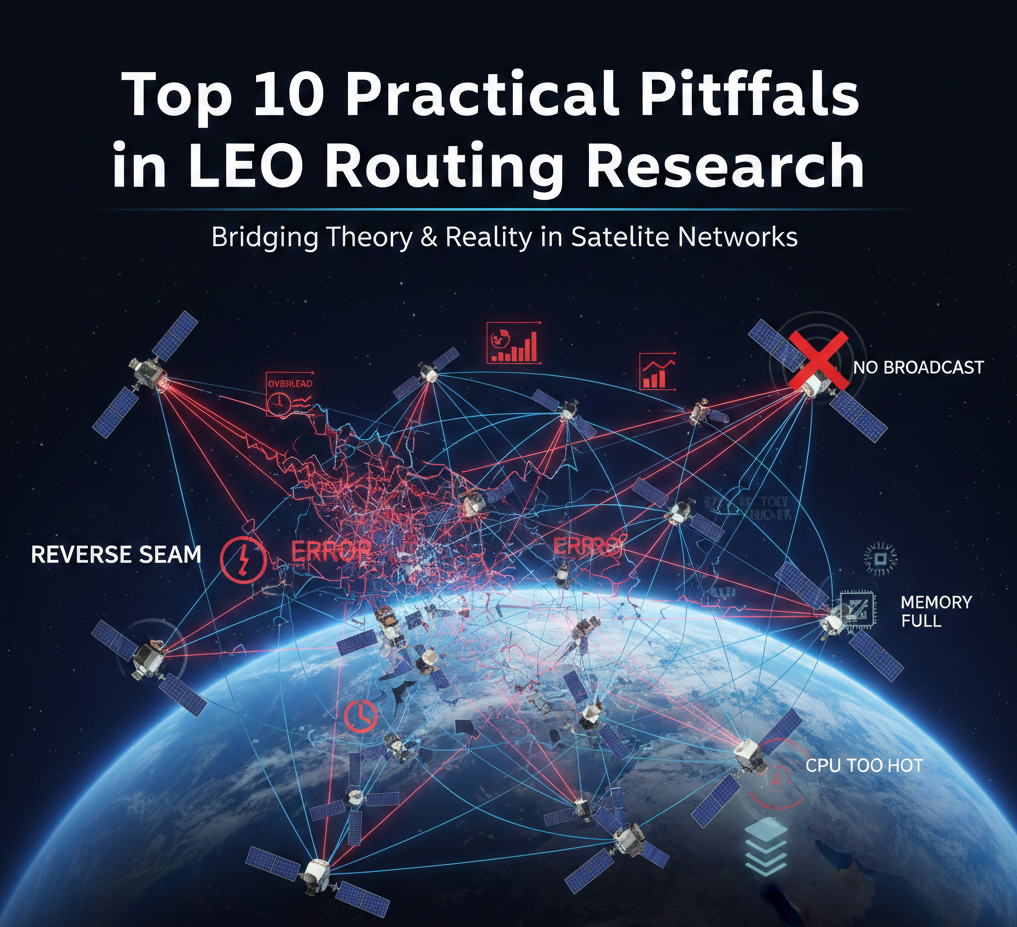
Designing routing protocols for Low Earth Orbit (LEO) satellite networks requires a fundamental shift from terrestrial networking logic. While academic research often treats satellites as highly mobile nodes in a vacuum of infinite resources, the transition to industry practice reveals a landscape defined by deterministic orbital mechanics, extreme hardware limitations, and the physical constraints of laser-based optics. For a scholar, the challenge lies in moving beyond “paperware” and addressing the “physics-first” engineering that governs networks like Starlink or Kuiper. This guide highlights the most common architectural blind spots where theoretical models often fail the test of real-world implementation.
The following guide is designed for research scholars to help them pivot from purely theoretical routing concepts to models that can survive an industry review (e.g., from SpaceX, Amazon Kuiper, or 3GPP standards boards).
🛰️ Top 10 Practical Pitfalls in LEO Routing Research
- The “Neighbor Discovery” Mistake: Attempting to find nodes via terrestrial-style “Hello” broadcasts in a point-to-point laser environment.
- The “Zero-Cost Switching” Mistake: Ignoring the multi-second physical alignment time (PAT) required to steer a laser terminal to a new neighbor.
- The “Infinite CPU/RAM” Mistake: Proposing complex machine learning or optimization models that exceed the capabilities of radiation-hardened processors.
- The “Continuous Mesh” (Torus) Mistake: Assuming a seamless grid and failing to account for the “Reverse Seam” where cross-links are physically impossible.
- The “Bent-Pipe” vs. “Regenerative” Confusion: Designing Layer-3 IP headers for satellites that may only be capable of Layer-2 frame forwarding.
- The “Static Snapshot” Buffer Mistake: Failing to account for micro-bursts caused by time-varying propagation delays during a packet’s flight.
- The “Global State Synchronization” Mistake: Assuming satellites can share real-time congestion scores across the globe without the data becoming “stale” or drowning the link.
- The “Uniform Traffic” Mistake: Testing algorithms with random traffic patterns instead of high-density “Hotspot-to-Gateway” models (e.g., London to New York).
- The “Infinite Memory” (Routing Table) Mistake: Neglecting the storage limits for massive, time-indexed routing snapshots on board the satellite.
- The “Ideal Handover” Mistake: Overlooking the “break-before-make” packet gaps that occur during the physical disconnection and reconnection of satellite-to-ground links.
The following section explains the above 10 practical pitfalls in detail and gives some directions to avoid them.
An elaborate FAQ and Guide for implementing the routing algorithm under the LEO Network
In fact, there is no difference in our perception of LEO and a Ug’s (cavemen’s) perception of LEO. In fact, the brains of most of us are not at all evolved enough to really grasp and understand the mechanism of routing in practical LEO networks.
As a fellow Ug, I try to present some questions and answers to stimulate our brains so that they could grasp at least some aspects of routing in LEO.
 In the rapidly evolving landscape of 6G and non-terrestrial networks (NTNs), Low Earth Orbit (LEO) satellite constellations have emerged as the final frontier for global connectivity. However, the transition from terrestrial “flat” networking to the high-velocity, three-dimensional reality of space is fraught with complexity. While academic literature is rich with elegant, decentralized routing algorithms, the industry frequently finds these “paperware” solutions incompatible with the physical rigors of spaceflight.
For researchers, the challenge is no longer just finding the shortest path; it is designing systems that can survive radiation-hardened hardware constraints, laser-link pointing delays, and the predictable yet brutal geometry of orbital mechanics.
This guide serves as a bridge between high-level theory and the rugged engineering requirements of modern LEO networks, identifying the core areas where theoretical models must evolve to become practically viable. It will help to understand how the routes are practically resolved in an SDN-based LEO Network.
The following FAQ section will help the scholars to get clear picture on LEO networks and how they really route packets in them.
🛠️ Summary for the “Thesis Defense.”
If a reviewer asks: “Why is your algorithm better than what Starlink uses?”
The wrong answer: “It finds a 5% shorter path.” (Industry doesn’t care about 5% if it risks stability).
The right answer: “It provides Local Resiliency. While the industry uses ground-computed static paths, my algorithm handles unpredictable local failures (solar flares, hardware reboots, or sudden traffic spikes) that the ground station cannot see in real-time.”
The real fact: Even though your answer may convince a reviewer/examiner in one way or another, the very naked truth is : your funny, clustering-based algorithm will never compete with the practical, SDN-based routing of Satarlink ever in a single aspect- other than the best, top, worst performing routing algorithm for LEO.
Ok. How do I defend my research more logically?
Still, there is a logical way to defend your research against such stunning questions. The following section explains the ethically acceptable and logically correct trick.
📝 Summary Checklist for Scholars
| Feature | Avoid (Academic Trap) | Adopt (Industry Standard) |
| Connectivity | Dynamic/Random links | Fixed/Scheduled ISL Graph |
| Control | Fully Centralized (Ground Only) | Hybrid (SDN Ground + Local Edge) |
| Medium | Omni-directional RF | Directed Beamforming / Laser |
| Mobility | Random Waypoint | Deterministic Keplerian Orbits |
| Simulation | Standard ns-3 Point-to-Point | ns-3-leo with SGP4 Mobility |
 Take Me to Afarion ns-3 iPlayground