Discuss Through WhatsApp
The rapid democratization of generative AI has produced an unprecedented paradox in academic publishing: while writing a scientific manuscript has never been easier, getting published in an elite Q1 journal has never been more difficult.
Over the past twenty-four months, leading publishing houses—including IEEE, Elsevier, Springer Nature, and Wiley—have witnessed an exponential influx of manuscript submissions. Powered by large language models (LLMs), researchers can now polish prose, format syntax, and synthesize literature surveys in minutes rather than weeks. However, this productivity dividend has overwhelmed editorial offices. Submissions across flagship IEEE Transactions and top Elsevier journals have surged by 25% to 40% year-over-year, creating severe reviewer fatigue, bottlenecked editorial queues, and a deluge of synthetically fluent but scientifically superficial manuscripts.
In defensive response, high-impact Q1 journals have constructed an aggressive, multi-layered technological defense. They have deployed automated pre-screening algorithmic bots, empowered Associate Editors with vector-space semantic triage engines, and armed peer reviewers with automated mathematical and reproducibility audit tools. Today, desk-rejection rates across premier Q1 journals routinely exceed 70% to 85%—with the vast majority of manuscripts rejected before an Associate Editor ever invites an external human reviewer.
💡 The Publishing Paradigm Shift
In the pre-AI era, clear prose and grammatical fluency provided non-native English scholars with a distinct competitive advantage. In the AI era, fluency is a baseline commodity. The modern battle for Q1 publication is no longer fought on language—it is fought on verifiable methodological depth, empirical transparency, mathematical defensibility, and algorithmic compliance.
To guide doctoral researchers, postdoctoral fellows, and principal investigators navigating this high-stakes landscape, this treatise deconstructs the contemporary three-tier Q1 journal gatekeeping pipeline and establishes a concrete, stage-by-stage engineering blueprint to navigate from submission to final acceptance.
Part 1 — Inside the Modern Q1 Editorial Pipeline: How AI is Used Against Your Manuscript
When you click “Submit Manuscript” on ScholarOne, Editorial Manager, or Elsevier’s Editorial System (EES), your PDF does not land on an editor’s desk. Instead, it enters an automated, multi-tiered evaluation pipeline designed to eliminate non-compliant or incremental papers as rapidly as possible. Understanding how these gatekeeping systems operate is the prerequisite for surviving them.
1. Automated Ingestion Gatekeepers (Pre-Editorial Desk Rejection)
The first filter is entirely algorithmic and executed within 24 to 72 hours of submission. Automated ingest bots (such as Penelope.ai, ScholarOne automated triage scripts, and publisher-specific intake APIs) parse the document’s structure, metadata, and citation integrity without human oversight:
- Structural and Declarative Completeness Auditing: Natural language processing (NLP) extractors scan the document for mandatory compliance statements. If your paper omits explicit, standalone subsections for Conflict of Interest, CRediT Author Statement (Contribution Roles), Ethics Approval / Institutional Review Board (IRB) Statements, Data Availability Statement, or Funding Grants / Disclaimers, the system immediately flags the manuscript as “Unsubmitted” or triggers an automated administrative rejection. Even in theoretical or pure simulation studies, stating “Data sharing not applicable to this article as no datasets were generated or analyzed during the current study” is required; leaving it absent causes an algorithmic bounce.
- Papermill Forensics and “Tortured Phrases” Parsing: Due to rampant academic paper mills churning out synthetic manuscripts, publishers run advanced heuristic classifiers. These engines specifically hunt for “tortured phrases”—bizarre word substitutions generated by automated spinning tools or uncalibrated LLMs attempting to evade plagiarism filters. Phrases such as “counterfeit consciousness” (instead of artificial intelligence), “colossal information” (instead of big data), “arbitrary access memory” (instead of random access memory), or “vital organization” (instead of vital signs) are flagged instantly. Concurrently, statistical perplexity and burstiness classifiers measure n-gram distribution uniformity; manuscripts exhibiting unnaturally uniform lexical cadence are tagged for high-scrutiny manual audit.
- Image Forensics and Splicing Detection: For experimental papers featuring microscopy, electrophoretic Western blots, or vector plots, automated visual forensic engines (such as Proofig or ImageTwin) scan all figures. They calculate cross-correlation matrices across sub-panels to detect cloning, contrast masking, rotation artifacts, and duplicate image patches across different published works in the publisher’s cross-journal repository.
- Live Citation and DOI Network Auditing: Perhaps the most lethal gatekeeper is automated reference resolution. Ingestion systems execute real-time API calls to Crossref, OpenAlex, and PubMed for every bibliographic entry in your reference list. The bot cross-verifies: (1) Does the DOI resolve to a live, registered publication? (2) Do author surnames, publication year, and journal title match the official metadata schema? (3) Does the cited paper actually exist? If an author relies on an LLM to format or suggest references, and the model hallucinates even a single non-existent reference or fabricated DOI, the manuscript is instantly desk-rejected, and the corresponding author’s profile is permanently red-flagged for academic misconduct.
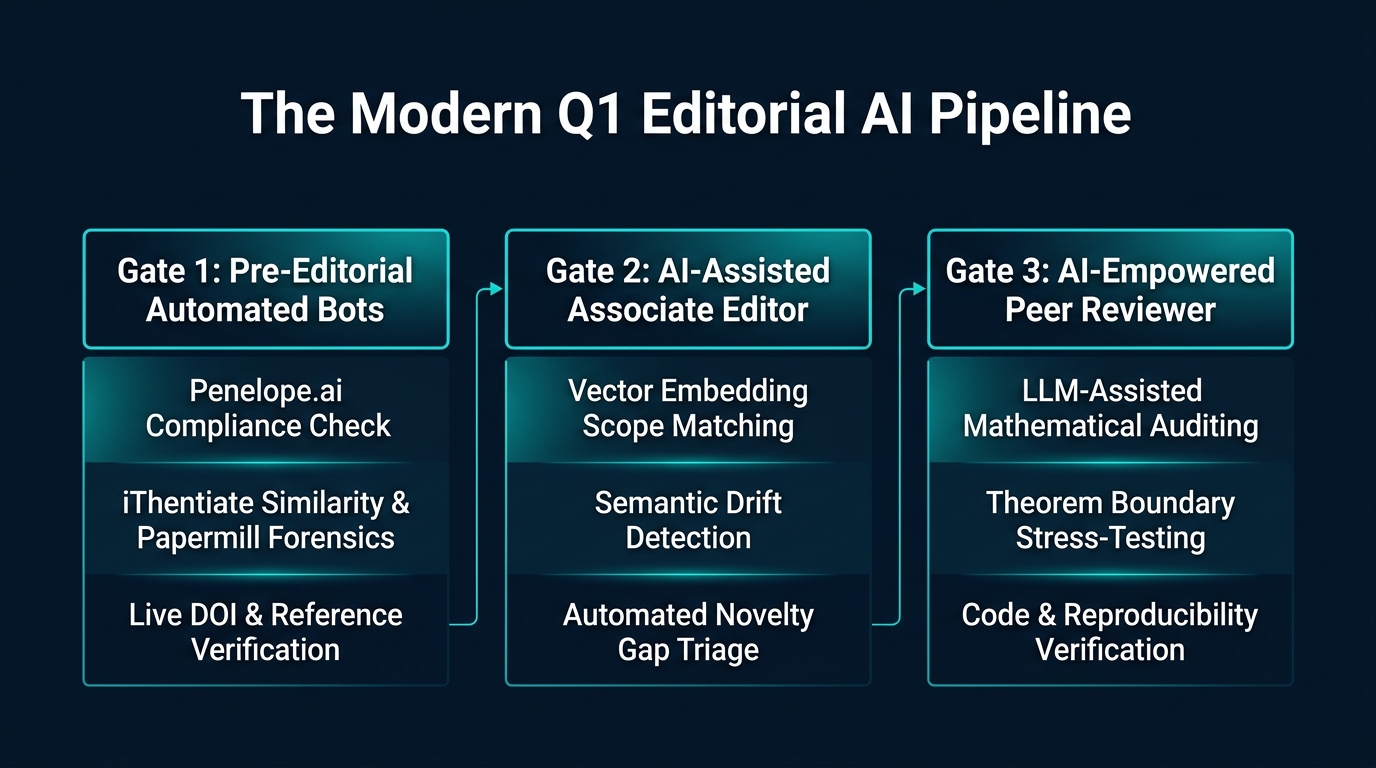
2. The AI-Assisted Associate Editor (Scope & Novelty Triage)
Once a manuscript survives Gate 1, it reaches the Editor-in-Chief (EiC) and Associate Editor (AE). Handling 15 to 30 new submissions per week on top of their full-time academic appointments, AEs now rely heavily on publisher-provided AI decision-support dashboards (such as Elsevier’s Scopus Triage Assistant, Springer Nature’s Snapp AI, or ScholarOne Manuscript Matcher):
- Vector Space Semantic Scope Drift: Modern editorial dashboards convert the submission’s Title, Abstract, Introduction, and Keyword vectors into dense, high-dimensional semantic embeddings (using fine-tuned models such as SPECTER2 or SciBERT). The system computes the cosine similarity cos(θ) between the submission vector v⃗paper and the centroid vector of the journal’s published corpus over the previous 36 to 60 months v⃗journal:
Scope Match Score=v⃗paper · v⃗journal||v⃗paper|| × ||v⃗journal||
If the calculated scope match score falls below an editorial threshold (typically < 0.72), or if the submission clusters predominantly in an adjacent discipline (e.g., pure software implementation submitted to a hardware-focused IEEE Transactions), the dashboard highlights: “High Semantic Drift: Manuscript Scope Misaligned with Recent Publications.” The AE issues an immediate desk rejection with the standard form rejection: “While your work is of interest, it falls outside the immediate scope and readership of this journal.”
- Automated Novelty Gap-Analysis: Editorial AI tools automatically extract your proposed contribution statements and query academic knowledge graphs (Web of Science, Scopus, Google Scholar) to locate the closest published literature. The editor’s summary panel generates a concise gap assessment:
Automated Editorial Triage Flag: “Submission shares 84% methodological overlap with Chen et al. (IEEE Trans. Mob. Comput., 2024). Proposed contribution represents an incremental parameter adjustment (α-factor scaling) in ns-3 without new theoretical derivation or architectural baseline.”
With one glance at this automated summary, an AE can justify a desk rejection in less than 90 seconds.
3. The AI-Empowered Peer Reviewer (Deep Theoretical & Mathematical Auditing)
If your manuscript successfully reaches external peer review, you face an entirely new challenge. While academic publishers officially restrict feeding confidential manuscripts into public AI tools, a significant percentage of senior reviewers now utilize secure institutional LLMs, local offline reasoning models (e.g., locally hosted Claude or DeepSeek-R1 instances), and automated code analysis scripts to scrutinize submissions with surgical precision:
- Mathematical Stress-Testing & Boundary Checking: Reviewers input proposed mathematical equations, optimization formulations, and lemma statements into reasoning models to evaluate their asymptotic behavior. The AI tests edge-case limits: What occurs as N → ∞? Does the objective function blow up when the signal-to-noise ratio γ → 0? Is the optimization formulation strictly convex, or does the author falsely claim a global minimum without proving positive semi-definiteness of the Hessian matrix? Leaps of faith concealed by generic phrasing (e.g., “It can be readily seen that Eq. (4) converges…”) are flagged with devastating mathematical counterexamples.
- Unstated Assumptions and Theoretical Contradictions: An LLM auditor cross-references your methodology against classical theoretical constraints (such as Shannon capacity limits, Cramér-Rao lower bounds, Jensen’s inequality, or Lyapunov drift bounds). If your proposed scheduling algorithm claims a 40% throughput increase over the theoretical Shannon limit in a Rayleigh fading channel, the reviewer will expose the hidden flaw.
- Repository and Pseudocode Auditing: When authors provide GitHub repositories or supplementary Python/C++ code, reviewers execute automated code-auditing scripts. They inspect whether the training and testing sets suffered from data leakage, whether fixed random seeds were cherry-picked to conceal simulation volatility, and whether baseline algorithms were intentionally hobbled by sub-optimal hyperparameters.
Part 2 — Summary Matrix: Gatekeepers vs. Winning Researcher Strategies
To survive this algorithmic gauntlet, researchers must systematically align their submission preparation with the specific screening criteria applied at each stage. The following matrix contrasts the primary gatekeepers, their rejection triggers, and the winning countermeasures:
Part 3 — The Stage-by-Stage Survival Blueprint for Q1 Publication
Publishing consistently in IEEE Transactions, Elsevier COMNET/JNCA, or Nature-portfolio journals in 2026 requires abandoning naive submission practices. Below is the operational protocol engineered to pass every gatekeeper.
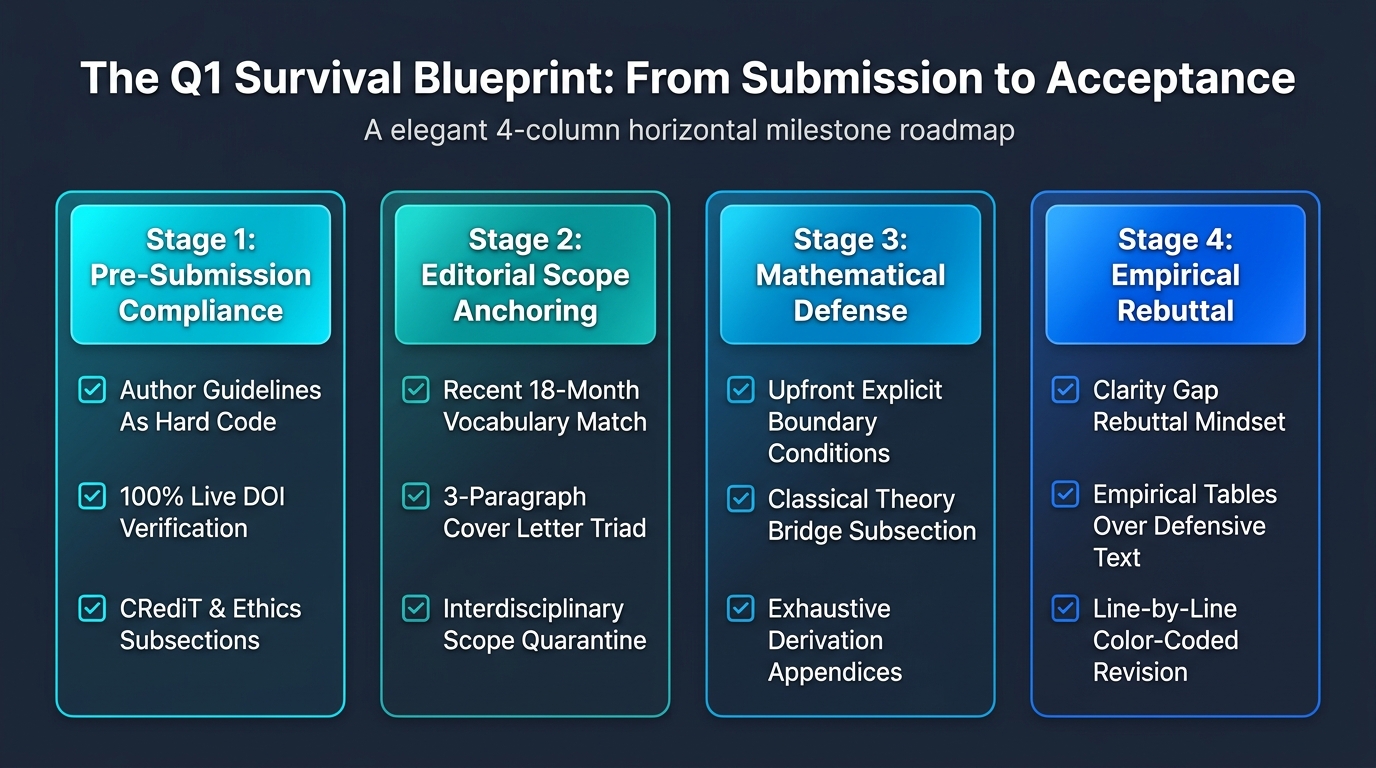
Stage 1: Bulletproofing Against Automated Desk Rejection
Before your paper is transmitted to an editor, it must achieve 100% compliance against automated ingest parsing:
 Take Me to Afarion ns-3 iPlayground