Discuss Through WhatsApp
Every wireless researcher who has ever compiled CTTC’s 5G-LENA module in ns-3 or explored its C++ protocol stack has wrestled with an inescapable question: If commercial flagship smartphones in our pockets already run 5G-Advanced silicon, and cellular carriers have already deployed multi-panel massive MIMO across commercial towers, why are open-source academic simulators still standardizing and calibrating those exact features months or years later?
At first glance, this gap looks like an unsettling paradox. To a graduate researcher, an ns-3 developer, or a telecom systems architect, it can appear as though academic simulation is perpetually chasing commercial shadows. When Qualcomm ships Snapdragon X75 and X80 modems executing 3GPP Release 18 features in physical silicon, while open-source simulation frameworks are actively rolling out calibrated implementations of those same mechanisms, an engineer might wonder: What is the scientific and industrial utility of simulating what already exists in commercial hardware?
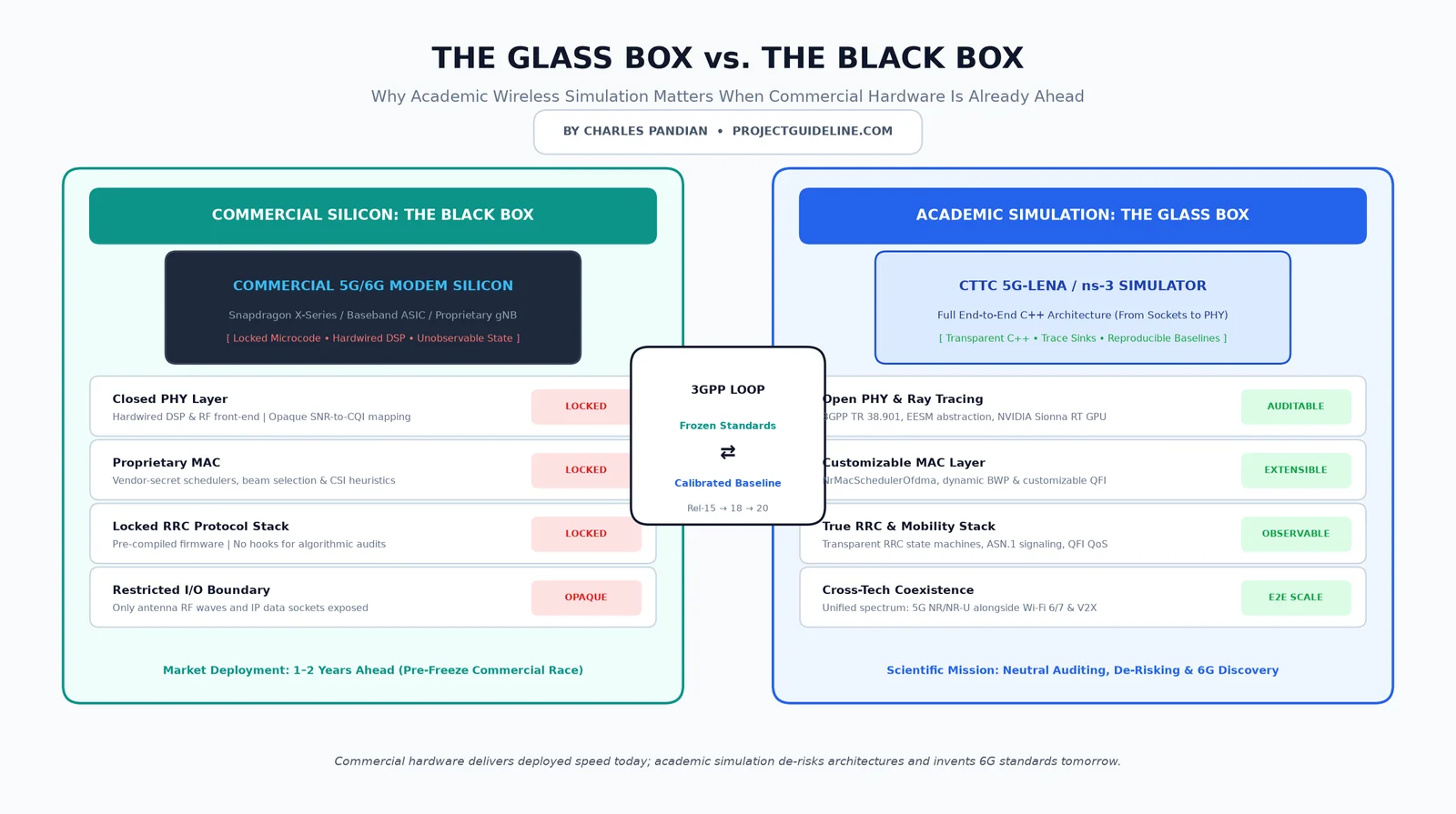
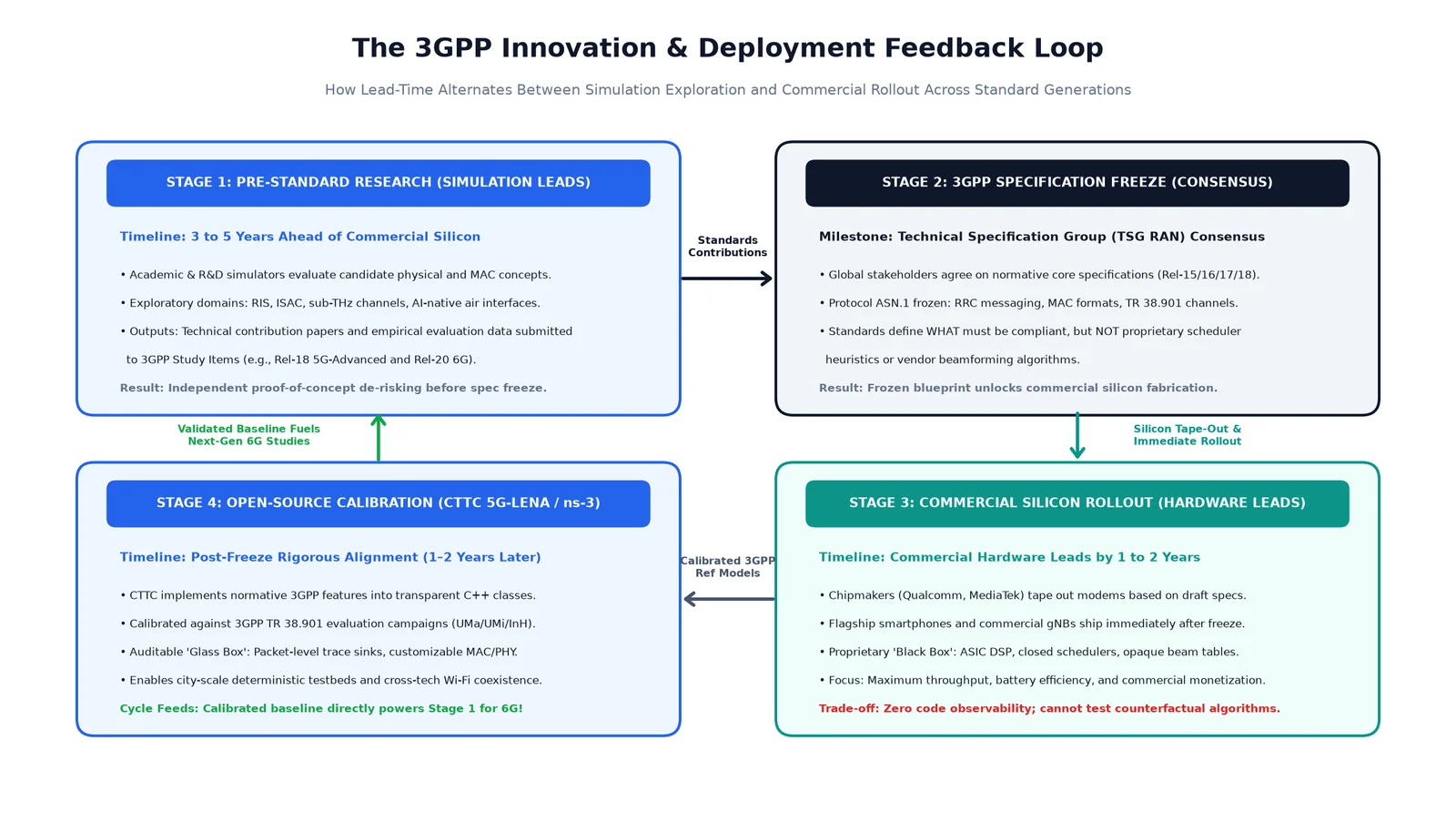
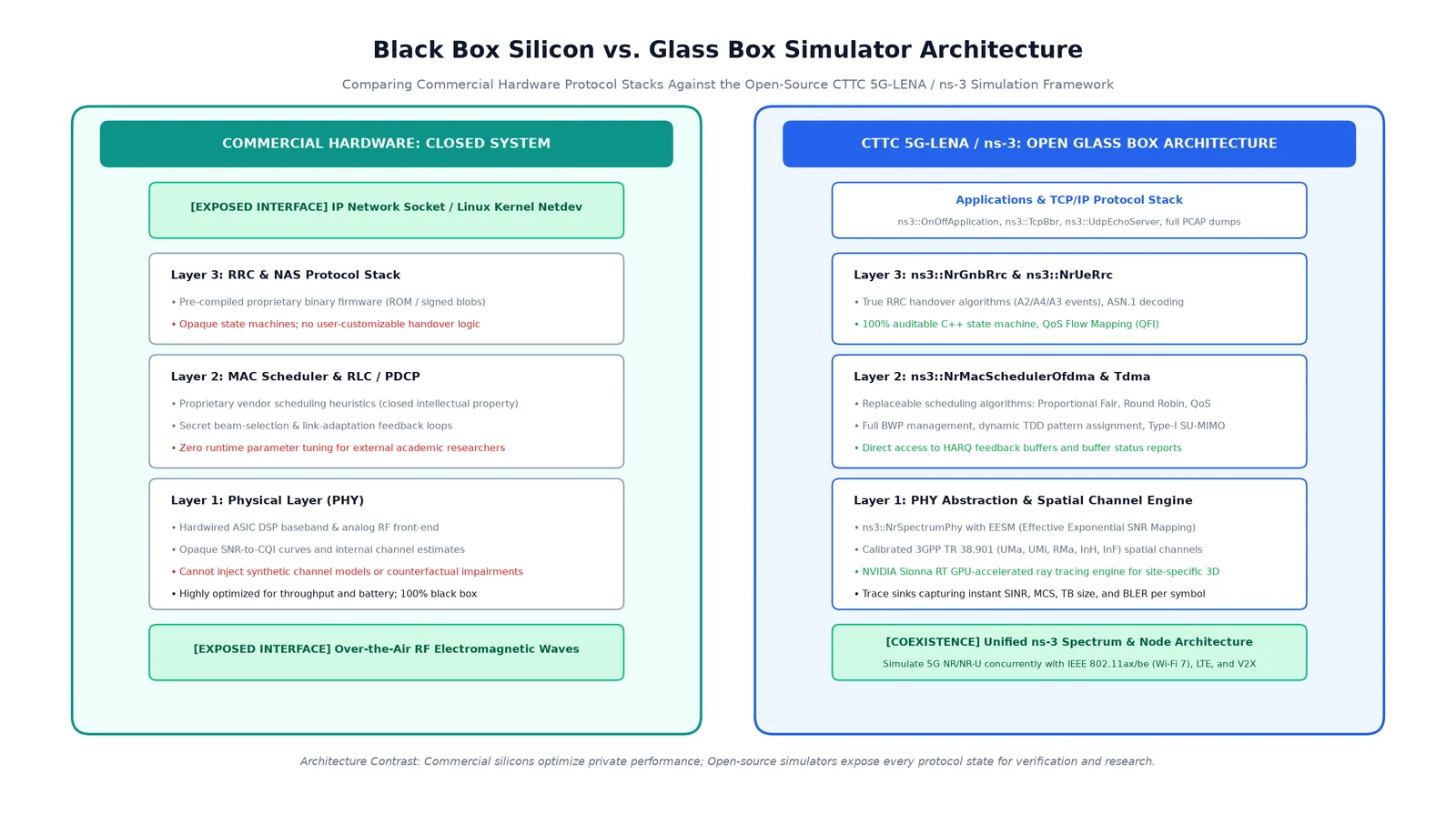
The answer lies in understanding the profound, irreconcilable difference between a commercial “Black Box” and an academic “Glass Box”. Commercial mobile hardware is engineered to monetize today’s frozen standards inside locked, proprietary silicon; open-source academic simulation is engineered to audit, de-risk, and invent tomorrow’s wireless standards. In this article, we dismantle the mechanics behind this timeline divergence, examine the concrete architectural trade-offs between physical-layer silicon and system-level simulators, and explain why open simulation remains the indispensable intellectual foundation of the global telecommunications ecosystem.
1. The Dual-Track Timeline: How Commercial Silicon Stays a Step Ahead (2018–2028)
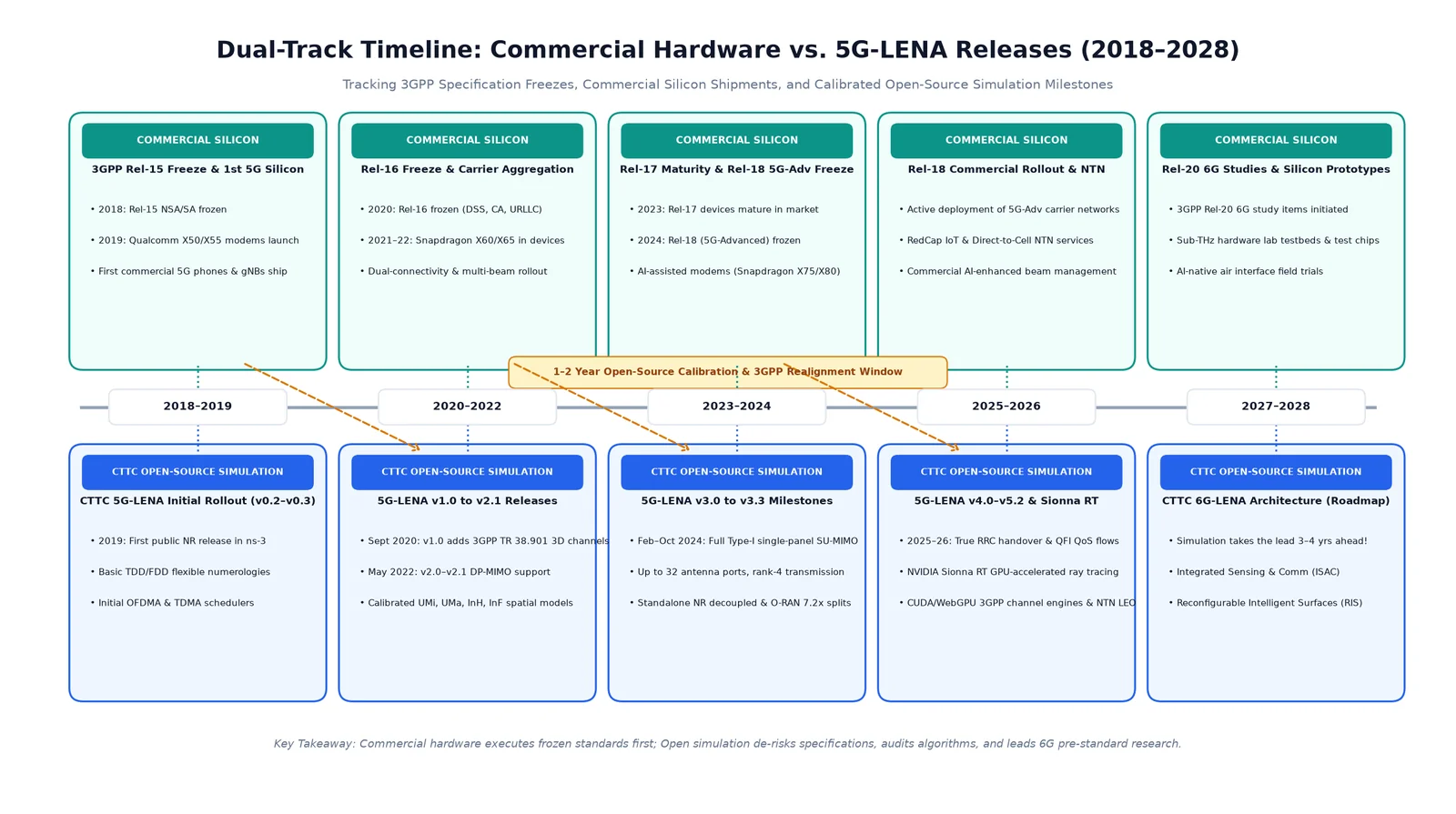
To evaluate the relationship between commercial hardware and open-source simulation, we must discard vague generalizations and examine concrete historical timelines. Across every 3GPP generation—from Release 15 New Radio to Release 18 5G-Advanced and the forthcoming Release 20 6G studies—commercial equipment manufacturers (Qualcomm, MediaTek, Ericsson, Nokia) and open-source simulation consortia (spearheaded by the Centre Tecnològic de Telecomunicacions de Catalunya, CTTC) follow two parallel, interdependent tracks.
2018–2019: 3GPP Release 15 & The Initial 5G Rollout
The 3GPP Technical Specification Group (TSG) RAN officially froze Release 15 Non-Standalone (NSA) in late 2017 and Standalone (SA) in June 2018. Commercial semiconductor vendors had already begun drafting hardware ASICs based on pre-standard working group agreements. As a result, Qualcomm launched the Snapdragon X50 and X55 modems, and commercial millimeter-wave (FR2) and sub-6 GHz (FR1) smartphones and gNodeBs (gNBs) hit global carrier networks throughout 2019.
Simultaneously, CTTC researchers released the foundational open-source 5G-LENA module (versions v0.2 through v0.3) in 2019. Operating inside ns-3, this initial module established flexible numerologies (subcarrier spacing from 15 kHz to 240 kHz), basic Orthogonal Frequency-Division Multiple Access (OFDMA), Time-Division Multiple Access (TDMA) symbol-level schedulers, and initial link-to-system mapping. While commercial vendors rushed to prove RF link stability on field testbeds, academic simulation was laying the mathematically rigorous, modular groundwork upon which end-to-end network stacks could be modeled.
2020–2022: 3GPP Release 16 & Spatial Channel Calibration
In July 2020, 3GPP froze Release 16, bringing standardized support for Dynamic Spectrum Sharing (DSS), industrial Ultra-Reliable Low-Latency Communication (URLLC), advanced carrier aggregation, and enhanced multi-input multi-output (eMIMO). Within twelve to eighteen months (2021–2022), silicon like the Snapdragon X60 and X65 brought these capabilities to commercial handsets, allowing carrier aggregation across distinct FDD and TDD spectrum bands.
In the academic simulation world, CTTC released 5G-LENA v1.0 in September 2020, followed by v2.0 and v2.1 across April–May 2022. This era marked a monumental shift in academic realism: CTTC integrated fully calibrated 3GPP TR 38.901 three-dimensional spatial channel models (Urban Macro [UMa], Urban Micro [UMi], Rural Macro [RMa], Indoor Hotspot [InH], and Indoor Factory [InF]). For the first time, researchers could execute end-to-end simulations with Dual-Polarized MIMO (DP-MIMO), beamforming gain matrices, and spatial correlation, all strictly calibrated against 3GPP calibration campaigns.
2023–2024: Release 17/18 vs. Full SU-MIMO & O-RAN Splits
By 2023, Release 17 devices had entered widespread commercial maturity, and in 2024, 3GPP officially froze Release 18—the landmark kickoff of 5G-Advanced. Modems such as the Snapdragon X75 and X80 introduced dedicated hardware tensor accelerators to manage real-time beam prediction and sub-carrier tracking.
During this same window (February–October 2024), CTTC delivered 5G-LENA v3.0 through v3.3. This release series completed full 3GPP Type-I single-panel Single-User MIMO (SU-MIMO) support for up to 32 antenna ports and rank-4 spatial multiplexing. Critically, version 3.0 decoupled the NR module entirely from legacy LTE dependencies, enabling standalone, high-performance C++ execution and laying the architectural groundwork for Open RAN (O-RAN) Option 7.2x functional split interfaces directly inside ns-3.
2025–2026: 5G-Advanced Maturity vs. Real RRC Handover & GPU Ray Tracing
Across 2025–2026, commercial operators have actively deployed 5G-Advanced capabilities: Reduced Capability (RedCap) IoT chipsets, multi-carrier uplink aggregation, and direct-to-cell Non-Terrestrial Network (NTN) satellite links for commercial handsets.
In response, CTTC rolled out 5G-LENA v4.0–v4.2 (spanning mid-2025 into early 2026) and v5.0–v5.2 (spanning mid-to-late 2026). These versions delivered two transformative capabilities to the ns-3 community:
- True 3GPP RRC Handover & QoS Flows (QFI): Replaced idealized handover shortcuts with full Radio Resource Control (RRC) signaling state machines, event-triggered measurement reports (A1, A2, A3, A4, A5), and standard 5G QoS Identifier (5QI) flow mappings.
- GPU-Accelerated Ray Tracing via NVIDIA Sionna RT: Solved ns-3’s traditional computational bottleneck by integrating with GPU-accelerated ray tracing frameworks (such as NVIDIA Sionna RT and CUDA/WebGPU 3GPP channel engines). Instead of relying solely on statistical stochastic models, researchers can now simulate physical 3D urban geometries with real-time multi-path ray tracing while ns-3 handles the discrete-event MAC, RLC, and TCP protocol logic.
2. Why Commercial Silicon Moves Faster: The Architectural Divergence
To understand why commercial hardware reaches consumers before an open-source simulator implements the same features, one must inspect how the two engineering systems are designed and funded. They do not share the same constraints, execution targets, or mathematical objectives.
| Design Dimension | Commercial Hardware (Qualcomm, Ericsson, Nokia) | Academic Simulators (CTTC 5G-LENA / ns-3) |
|---|---|---|
| Primary Engineering Objective | Time-to-market, thermal dissipation, battery endurance, and monetizing frozen standards through peak RF link budgets. | Reproducible algorithmic transparency, protocol neutrality, modular auditability, and de-risking future 3GPP releases. |
| Physical Layer Execution | Exact DSP Waveform Processing: Real-time ADC/DAC sampling, FFT/IFFT, hardwired LDPC/Polar decoders, and analog RF beamforming. | PHY Abstraction (EESM / MIESM): Link-to-system mapping curves translating instantaneous SINR across resource blocks into Block Error Rate (BLER) lookups. |
| Development Driver & Roadmap | Pre-freeze drafts; chipmakers participate directly in working groups and tape out silicon before final specification publication. | Post-freeze normative calibration; open-source maintainers require finalized 3GPP specifications and calibration datasets to ensure validity. |
| Internal Observability | Zero (Locked Black Box): Proprietary firmware blobs, locked MAC schedulers, unobservable internal state registers, protected by NDAs. | 100% (Transparent Glass Box): Complete C++ source code access, configurable trace sinks, per-symbol SINR logs, and native PCAP packet dissections. |
| Network Scale & Cost | Severe financial and spatial limitations: physical testbeds are limited to 3–10 gNBs; RF channels suffer from unrepeatable atmospheric drift. | Arbitrary scalability: run 50+ gNBs, hundreds of multi-beam cells, and thousands of UEs deterministically on commodity workstations or server clusters. |
As the table illustrates, the 1–2 year commercial “lead” is not a failure of academic capability; it is the natural consequence of chipmakers developing in parallel with pre-standard working groups to capture consumer market share the moment standards freeze. Conversely, academic simulators must wait for standards to stabilize: building an open-source reference implementation against shifting draft text is an inefficient use of public research funds.
3. Five Pillars: Why Academic Simulation Is Indispensable
If commercial silicon is already executing 5G-Advanced and 3GPP Release 18 in the wild, why does the global telecommunications industry continue to pour millions of dollars and countless engineering hours into open-source academic simulators? There are five definitive reasons:
Pillar 1: Shattering the “Black Box” Barrier
When you buy a commercial 5G smartphone or lease a commercial gNodeB, you do not receive an open telecommunications laboratory. You receive an impenetrable black box. The baseband modem runs proprietary, pre-compiled binary firmware. The MAC scheduler—the intellectual crown jewel where a vendor decides how Resource Blocks (RBs), Modulation and Coding Schemes (MCS), and MIMO precoding matrices are assigned every slot—is locked behind aggressive trade secrets and non-disclosure agreements (NDAs).
If a researcher hypothesizes a revolutionary reinforcement-learning MAC scheduler or an adaptive HARQ retransmission threshold, they cannot flash that code onto a commercial Qualcomm modem or an Ericsson base station. Even software-defined radio (SDR) testbeds (such as OpenAirInterface or srsRAN) struggle with computational latency at high bandwidths and lack the full protocol instrumentation needed for end-to-end evaluations.
In 5G-LENA, every layer of the protocol stack is an open C++ class. Want to inspect the instantaneous Channel Quality Indicator (CQI) calculations inside NrAmc::CreateCqiFeedbackWbTdma()? You simply read the source code. Want to replace proportional fair scheduling with a custom multi-agent graph neural network? Subclass NrMacSchedulerNs3 and override the slot allocation methods. Simulation is the only environment where an engineer has absolute, God-like observability and control over every byte from the Linux socket down to the simulated radio frequency channel.
Pillar 2: Deterministic Reproducibility at City Scale
Real-world radio frequency environments are inherently non-repeatable. If you drive a test vehicle through downtown Chicago on Tuesday morning to evaluate 5G handover latency, your channel conditions will be shaped by moving buses, humidity, rain, temperature gradients, and fluctuating commercial cell loads. If you re-run the same drive test on Wednesday, you cannot replicate Tuesday’s RF propagation conditions.
Scientific discovery requires deterministic reproducibility. In ns-3, pseudo-random number generators (RNGs) are tied to explicit seeds and run numbers:
// Deterministic pseudo-random seed configuration in ns-3
RngSeedManager::SetSeed(12345);
RngSeedManager::SetRun(1);

// Configure 3GPP TR 38.901 Urban Macro spatial scenario
Ptr channel = CreateObject();
channel->SetAttribute("Scenario", StringValue("UMa"));
channel->SetAttribute("Frequency", DoubleValue(3.5e9)); // 3.5 GHz Mid-Band
channel->SetAttribute("ChannelConditionModel", CreateObject());
If an experiment encounters an anomalous packet drop at simulation timestamp t = 14.892401s, an engineer can re-run that exact script with the same seed and reproduce the drop with bit-exact precision down to the microsecond. Furthermore, simulation allows scaling to 50 gNodeBs, 200 distributed antenna arrays, and 5,000 active user devices generating terabytes of concurrent TCP/UDP traffic—a physical deployment that would cost tens of millions of dollars in hardware alone.
Pillar 3: Neutral Auditing & Preventing Vendor Lock-In
When a major equipment vendor claims that their proprietary base station scheduler improves spectral efficiency by 34% or cuts handover failure rates in half, who audits that claim? Telecom operators cannot blindly take vendor marketing at face value, and national spectrum regulators (such as the FCC or ITU) cannot formulate national radio frequency policy based on private corporate simulations.
Open-source simulators act as the Switzerland of telecommunications. Because 5G-LENA is publicly maintained by CTTC and rigorously cross-validated against published 3GPP calibration campaigns, it serves as an impartial, peer-reviewed baseline. When a university or an operator evaluates an algorithmic optimization against 5G-LENA’s calibrated TR 38.901 channel models, the entire international research community can audit the simulation scripts, inspect the link-to-system mapping curves, and verify the findings.
Pillar 4: Cross-Technology Coexistence in Shared Spectrum
Commercial hardware vendors are vertically aligned: cellular chipmakers optimize for cellular bands, while Wi-Fi silicon manufacturers optimize for IEEE 802.11 standards. But modern wireless communication increasingly takes place in shared and unlicensed spectrum (such as the 5 GHz and 6 GHz bands where 5G NR-U and IEEE 802.11ax/be Wi-Fi 6/7 collide).
Because 5G-LENA lives inside the larger ns-3 ecosystem, it does not exist in a cellular silo. An engineer can construct an ns-3 simulation where a 5G NR-U base station using Listen-Before-Talk (LBT) Cat 4 channel access shares the exact same 6 GHz spectrum band with a dense mesh of IEEE 802.11be (Wi-Fi 7) multi-link access points and legacy LTE-LAA nodes:
[Application Layer: Concurrent VoD / UDP Telemetry / TCP BBR]
                  │
   ┌──────────────┴──────────────┐
   ▼                             ▼
[5G-LENA: NrNetDevice]    [ns-3: WifiNetDevice (802.11be)]
   │                             │
   ▼                             ▼
[NR-U LBT Cat-4 Engine]   [Wi-Fi Enhanced Distributed Channel Access]
   │                             │
   └──────────────┬──────────────┘
                  ▼
[Unified SpectrumChannel / 3GPP Spatial Propagation Model]
You cannot buy a physical bench test setup off the shelf that provides this level of joint spectrum observability across competing standards without building a multi-million-dollar shielded anechoic chamber. In ns-3, it is simply a matter of configuring modular network devices on a shared spectrum channel.
Pillar 5: Fueling Industry’s Own R&D & The Telecom Talent Pipeline
Perhaps the most telling piece of evidence is this: the very corporations that manufacture commercial black-box silicon are the primary sponsors and users of academic simulation.
Organizations such as InterDigital, Huawei, Meta, NVIDIA, the National Institute of Standards and Technology (NIST), and the Wi-Fi Alliance actively contribute code, fund research chairs, and sponsor module development in 5G-LENA and ns-3. The recent integration of NVIDIA Sionna RT with 5G-LENA for GPU-accelerated ray tracing was born out of direct industry-academic collaboration.
Why do commercial giants fund open simulation? Because even for Qualcomm or Ericsson, spinning a test silicon fabrication run costs millions of dollars and takes nine months. Simulation is where industrial researchers prototype radical ideas before committing them to silicon layout. Furthermore, ns-3 is the premier training ground for wireless engineering talent: graduate students who master protocol design, EESM abstraction, and spatial channel modeling in 5G-LENA become the senior systems architects who design the next generation of commercial cellular modems.
4. Looking Toward 2027–2028: The Cycle Repeats with 6G-LENA & Rel-20
As the wireless community moves through 2026 and looks toward the 2027–2028 horizon, the apparent contradiction between commercial hardware and simulation resolves into an elegant historical rhythm.
Right now, commercial hardware leads in the deployment of 5G-Advanced (Release 18). But as 3GPP initiates formal study items for Release 20—the technical foundation of 6G—commercial hardware will once again have nothing to ship. There are no commercial 6G modems, no sub-terahertz base stations, and no mass-market Reconfigurable Intelligent Surface (RIS) chipsets.
And who takes the lead during this pre-standardization vacuum? Academic simulation.
CTTC’s roadmap for 6G-LENA (slated for mature deployment across 2027–2028) is already laying the architectural groundwork for:
- Integrated Sensing and Communication (ISAC): Joint waveform modeling enabling network nodes to act concurrently as communication transmitters and radar sensors.
- Reconfigurable Intelligent Surfaces (RIS): Metasurface phase-shift matrix models integrated directly into spatial ray tracing pipelines.
- Sub-THz & Extremely Large-Scale MIMO (XL-MIMO): Moving beyond 32 antenna ports into the near-field propagation regimes of 140 GHz and 300 GHz.
- AI-Native Air Interfaces: Direct neural-network-driven channel estimation and autoencoder-based physical layer abstractions replacing classical Fourier transform basebands.
From 2027 to 2029, researchers running 6G-LENA in ns-3 will be publishing the empirical throughput, latency, and spectral efficiency datasets that will guide 3GPP delegates inside TSG RAN meeting rooms. When those delegates finally freeze the initial 6G specifications around 2029–2030, commercial chipmakers will seize those frozen blueprints and race to fabricate consumer 6G modems. The baton will pass once more.
5. Summary & Concluding Thoughts
If you are a graduate student, a simulation engineer, or an R&D architect, never let anyone tell you that academic simulation is irrelevant because commercial hardware is “ahead.” Commercial hardware and open simulation are not competitors running the same race on the same track; they are symbiotic partners in an unending technological cycle.
Commercial hardware delivers deployed speed, battery efficiency, and market monetization today. Open-source simulation provides the scientific rigor, algorithmic transparency, deterministic reproducibility, and architectural freedom required to invent the standards of tomorrow. The locked black box keeps our world connected; the transparent glass box ensures our collective wireless future remains open, verifiable, and boundless.
References & Further Reading
- Patriciello, N., Lagen, S., Bojovic, B., & Giupponi, L. (2019). An E2E simulator for 5G NR networks. Simulation Modelling Practice and Theory, 96, 101933. doi:10.1016/j.simpat.2019.101933
- Lagen, S., Bojovic, B., Polese, M., Giupponi, L., & Zorzi, M. (2020). The new 5G-LENA module in ns-3: Architecture, design, and validation. Proceedings of the Workshop on ns-3 (WNS3), 2020.
- Centre Tecnològic de Telecomunicacions de Catalunya (CTTC). (2024–2026). 5G-LENA Features, Roadmap & Release Notes (NR-v3.0 through NR-v5.2). Available at: https://5g-lena.cttc.es/features/roadmap/
- CTTC OpenSim Research Unit. (2025–2026). Integrating NVIDIA Sionna RT and GPU-Accelerated 3GPP TR 38.901 Channel Models into ns-3 / 5G-LENA. Available at: https://5g-lena.cttc.es/blog/
- 3GPP Technical Specification Group Radio Access Network. Release 15, 16, 17, and 18 (5G-Advanced) Specifications & TR 38.901 3D Channel Model. 3rd Generation Partnership Project (3GPP).
 Take Me to Afarion ns-3 iPlayground